Hudson River Trading Interview Questions: What HRT Looks For
How HRT interviews algorithm developers and software engineers, the fundamentals it tests, why candidates fail in its own words, and how to prepare.
Hudson River Trading (HRT) is one of the most engineering-heavy firms in quant trading, and its interviews reflect that. If you come from big tech you will recognise much of the process. What catches people out is the depth. HRT wants to know whether you understand the tools you use or have only used them.
HRT is also fairly open about how it hires. Its tech blog, The HRT Beat, has two posts on interviewing: a campus software engineering guide from 2021 and a longer post by engineer Joe Smith from October 2025 on how engineering is organised and why candidates fail. Its student opportunities page answers the practical questions. Most of this guide comes from those pages (read in October 2026). Where we fall back on what candidates report, we say so.
The roles you can interview for
HRT hires into several job families, and the interview depends on which one you apply to. The three most candidates care about:
| Role | What the job is | Interview languages |
|---|---|---|
| Algorithm Developer | Research and implement trading strategies: statistics, data analysis and modeling, written in C++ and Python | Your choice of C++ or Python |
| Software Engineer | Build the live trading system and the research environment | You state a C++ or Python preference when you apply |
| Algorithm Engineer | Make the trading teams' research tools and trading platform fast and easy to use, working closely with Algo Developers | C++ and/or Python, depending on the team |
HRT's FAQ draws the line between the last two clearly: Algorithm Developers build and maintain the models that drive trading, and Algorithm Engineers (with Software Engineers) build the tools and platform those models run on. Inside HRT, "Algo" means the trading teams, and HRT describes Algo Development as "aka quantitative research and trading."
The 2025 post adds a useful map of engineering. It splits into Trading Tech, which handles everything needed to trade today (exchange market data, order entry, FPGA and ASIC acceleration, clearing), and Research and Development, which handles history (storage, compute clusters, data pipelines, research tools). Joe Smith puts Trading Tech at roughly 70% C++ and 30% Python, R&D the other way round, and says the quality bar is the same for both. Trading Tech's hardest problem is latency, and R&D's is scale.
Most roles flow through the same pipeline, so HRT can move you toward a better-fitting team as the process goes on. The student FAQ asks you to apply to only one posting and use the application questions to flag other interests.
You do not need finance experience. HRT's FAQ says "the majority of HRTers join us with no previous finance experience."
What HRT says it looks for
The 2021 campus guide states it plainly: strong candidates "program, be effective communicators, and work through problems methodically." It also says it is fine to need hints, ask for guidance and make mistakes.
At the onsite, that guide lists three technical areas:
- Programming skills. Idiomatic code with modern syntax that uses resources well, is well encapsulated, and is easy to read.
- Systems-level knowledge. Memory, I/O and process management: "Can you understand what is happening under the hood?"
- Problem solving. Breaking down a problem you do not know how to solve and making steady progress on it.
Alongside those it scores collaboration (do you take hints, are you open to a different approach), teachability (do you apply ideas from earlier in the interview to later questions) and communication.
The 2025 post is blunter. It lists the most common reasons candidates fail, roughly in order of frequency:
- A shallow understanding of fundamentals. The examples are concrete: if you use virtual classes, do you know how most compilers implement them? If you use Python lists, do you know how their memory grows as they expand?
- Communication. HRT says it rates engineers "as much on communication as we do on technical ability."
- Not listening. Diving in before understanding the problem, or not letting the interviewer speak.
- Avoiding real work. Proposing an overly complex design instead of coding a practical answer. HRT gives the same technical tests to candidates at every level, "even if you were the CTO of your last company."
- Arrogance.
- Indifference. Not seeming to care about the work.
- Cheating. Candidates who use LLMs in early stages find the later stages much harder to fake, and HRT says it will not invite them back.
The same post explains what language choice implies. If you interview in C++, you are expected to know a fair amount about how computers work. If you interview in Python, you still need some systems knowledge, such as how virtual memory works, but less detail.
The interview process
HRT says its process changes from season to season and that your recruiter's description beats any blog post, including this one. With that caveat, here is what HRT has published.
Campus software engineering (2021 guide). A take-home test, roughly two phone interviews, then a full day of back-to-back interviews, onsite or virtual.
- Take-home test. Usually timed with a deadline, typically on HackerRank or Codility, and some roles restrict your language. You may use books or the internet as a language reference. Test your code properly, because the sample cases are not comprehensive. Style matters less here than correctness.
- Phone interviews. A 45-minute technical discussion on one of systems knowledge, data structures or problem solving, and a programming interview tailored to the team. Some roles require C++ or Python. Others let you choose.
- Onsite. The programming, systems and problem-solving areas above, plus collaboration and communication.
Internships follow "a slightly abridged" version of the same process.
Engineering in general (2025 post). The process starts with a series of video calls, which may be exploratory conversations or go straight into technical screens. Language options are C++, Python, or TypeScript with Python for full-stack roles. You may be given code in an unfamiliar language to analyse, and graders take your familiarity into account. Onsite interviews "are generally composed of coding and debugging rounds, technical design discussions, and team fit," and HRT prefers at least some of them in person.
One line in that post is worth remembering: HRT tries to avoid "burst of insight" LeetCode-style questions, and its ideal is that "a strong programmer from a competitive firm would ace our technical interview with no studying."
Algorithm Developer. HRT publishes less about this process. Its FAQ confirms you choose C++ or Python, and the role description centres on statistics, data analysis and programming. Candidates commonly report a mix of coding, probability and statistics questions, and discussion of data and modeling. Our superday guide notes that probability questions sometimes appear in engineering loops too. Expect the exact mix to vary by team and season.
The kinds of questions
Coding. Practical problems where you are expected to produce working, readable code and test it. The take-home rewards correctness on edge cases, and the onsite rewards code that someone else could maintain.
Debugging and reading code. HRT names debugging rounds explicitly. Reading unfamiliar code, finding what is wrong and explaining it is a skill you can practise.
Systems and fundamentals. Memory layout, virtual memory, caches, I/O, processes, how the compiler implements language features, and how standard containers behave. For C++ roles this goes deep. Our guide to C++ interview questions for HFT covers the topics low-latency firms ask about, from move semantics to false sharing.
Technical design. Discussions of how you would build a component, what the trade-offs are, and how you would test it.
Probability and statistics. Mainly for Algorithm Developer candidates. Expect questions that test whether you can model a problem and reason about data, not only compute an answer.
Your past work. HRT wants you to explain previous projects at the right level of detail for an interviewer who may not know your field, and to check whether they are following.
A worked example
Here is a fundamentals question in the style HRT's 2025 post describes. It is not a leaked question. It is the kind of "do you know how your tools work?" question that post gives as an example.
A dynamic array (a C++
std::vectoror a Python list) starts empty, and you append elements one at a time. Each time it runs out of space it allocates a new buffer twice the size and copies everything across. How much copying does that cost in total?
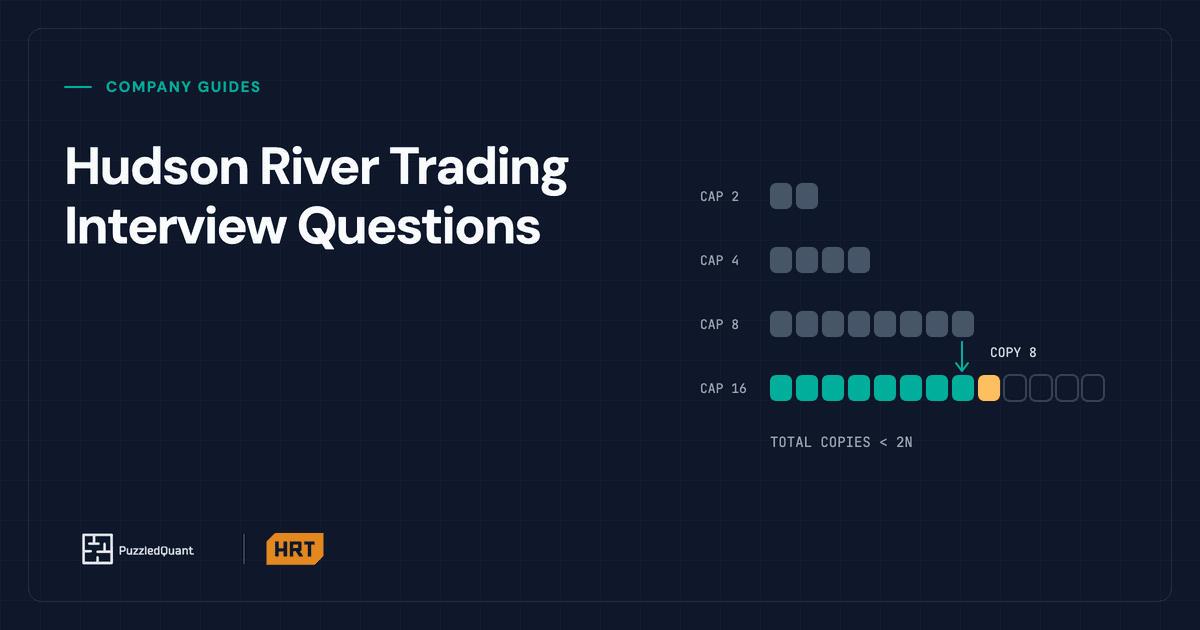
Copies happen when the size passes 1, 2, 4, 8 and so on, up to the largest power of two below . Each resize copies the current contents, so the total is
Fewer than copies for appends, so each append costs O(1) on average, even though a single append can cost O(n). That is amortised constant time, and you should be able to explain it this way rather than just state it.
The follow-ups are where the interview goes:
- Why double rather than add a fixed amount? Growing by a constant makes the total copying about , which is quadratic. Any constant growth factor above 1 keeps it linear.
- Why do some implementations grow by 1.5 instead of 2? With a factor below the golden ratio, the memory freed by earlier buffers can eventually be reused for a new one. With a factor of 2, each new buffer is bigger than all previous buffers combined. The trade-off is more frequent reallocation.
- What happens to a pointer or reference into the vector when it grows? It is invalidated, because the elements moved. This bites in real code.
- If you know in advance, what do you do? Call
reserve, so there is one allocation and no copying. - For C++: does it copy or move the elements? It moves them if the move constructor is
noexcept, and otherwise copies them to keep the strong exception guarantee.
A candidate who can work through those follow-ups, out loud and without a textbook, is showing the depth HRT's post asks for. A candidate who knows "push_back is amortised O(1)" and nothing more is showing the shallow understanding that post lists as the top reason people fail.
How to prepare
Pick your language and go deep in it. HRT lets you choose between C++ and Python for most roles, and the choice sets the depth expected. If you choose C++, know object lifetimes, move semantics, how virtual dispatch works, what the standard containers do in memory, and the basics of caches and concurrency. Our C++ roadmap for quant trading lays out a plan, and the C++ exercises give you graded practice on interview topics.
For every tool you use, learn how it works. Go through the data structures you reach for daily and make sure you can explain their implementation and costs: hash maps and collisions, dynamic arrays, balanced trees, heaps. Then do the same for the OS: virtual memory, page faults, system calls, what happens when a process forks.
Practise debugging as well as writing. Take working code, break it in a subtle way, and practise finding the bug while explaining your reasoning. Reading other people's code fluently is a separate skill from writing your own.
Do the take-home like it counts. Write your own tests beyond the samples, especially edge cases. Work through a small example on paper first, as HRT's own guide suggests.
For Algorithm Developer roles, add probability and statistics. Work through the probability problems and statistics problems, and read our probability interview questions guide. Be ready to talk about data you have actually analysed.
Use firm-tagged practice. PuzzledQuant tags problems by the firms known to ask them. The Hudson River Trading problems are a good calibration set, and the algorithms problems cover the coding side.
Practise communicating. HRT's own tips: practise talking out loud while you code, and practise explaining technical topics to a non-technical listener. Tell the interviewer when you need quiet time to think, when you change approach, when you spot a mistake, and when you have heard the problem before.
If you are still deciding between Algorithm Developer and engineering, our comparison of quant researcher, trader and developer roles explains how the jobs and interviews differ. For a full plan by role and timeline, see our guide to preparing for quant interviews.
What to do the week before
Ask your recruiter what each round will cover and in which language. HRT tailors its process to each role and team, and it tells you to treat the recruiter's information as the source of truth.
Then review rather than cram. Re-explain the fundamentals you worked through, out loud, as if to a colleague who does not know them. Re-solve a few debugging exercises. Prepare two or three past projects you can explain at whatever depth the interviewer wants. If any of your onsite is in person, plan the logistics so the day itself is only about the interviews.
HRT says it wants people who are "open, curious, kind, practical, and actually enjoy working." Its own list of failure reasons backs that up: several are about attitude rather than knowledge. Show that you like the work, listen properly, and write the simple solution before the clever one.
When you are ready, start with the HRT-tagged problems and the C++ exercises. Premium unlocks the full exercise set and problem bank; see pricing.
Frequently asked questions
What is the Hudson River Trading interview process?
For campus software engineering, HRT has described a timed take-home test, roughly two phone interviews, and a full day of back-to-back interviews, onsite or virtual. Its 2025 engineering post describes initial video calls, technical screens, and onsite interviews made up of coding and debugging rounds, technical design discussions, and team fit. The details vary by role and season, and your recruiter will tell you the structure of each round.
What programming language should I use for an HRT interview?
Algorithm Developer candidates choose between C++ and Python. Software Engineering candidates state a C++ or Python preference when they apply, and full-stack roles use TypeScript with Python. Interviewing in C++ means you are expected to know more about how computers work at a low level.
Does HRT ask LeetCode questions?
HRT says it tries to avoid "burst of insight" LeetCode-style questions and stays away from tricks and obscure knowledge. Expect practical coding, debugging and design problems that test strong fundamentals, such as how compilers implement virtual classes or how a Python list grows in memory.
What is the difference between an Algorithm Developer and an Algorithm Engineer at HRT?
Algorithm Developers build and maintain the models that drive HRT's trading, using statistics, data analysis and C++ or Python. Algorithm Engineers make the research tools and trading platform those developers use fast, flexible and easy to use, working closely with them.
Do I need finance experience to work at HRT?
No. HRT says the majority of its employees join with no previous finance experience and learn on the job and through its training program.