How to Prepare for Quant Interviews: The Complete 2026 Guide
A round-by-round plan for quant trader, researcher and developer interviews, with 4, 8 and 12-week schedules and links to every topic and firm guide.
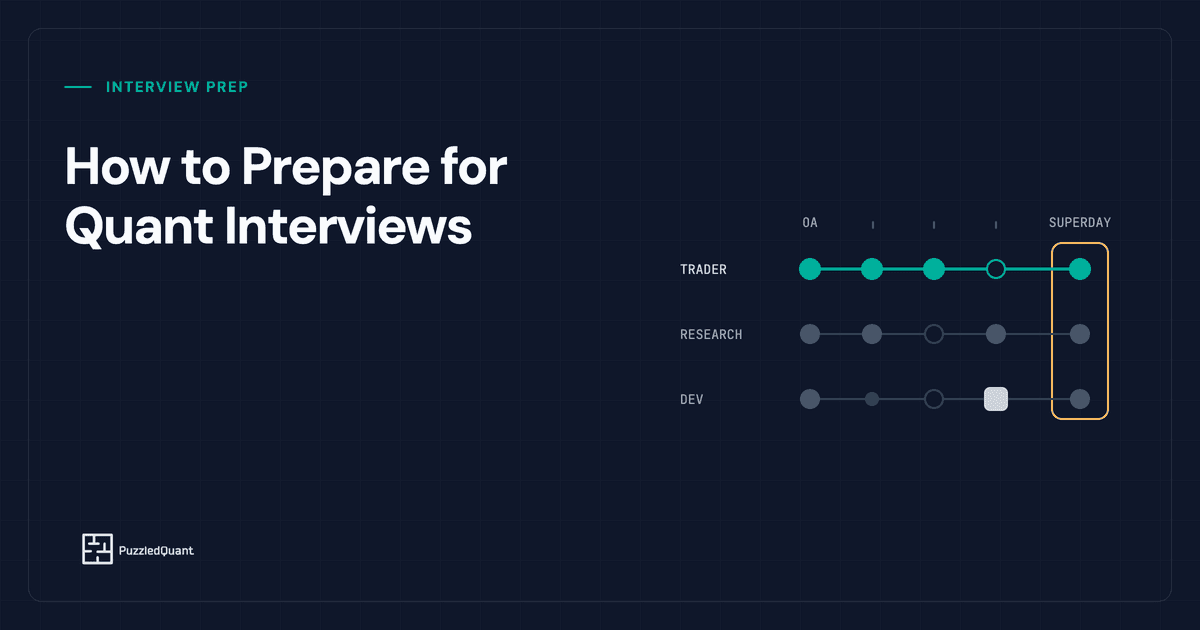
Most advice on preparing for quant interviews is a list of resources. A list is not a plan. A quant interview is a sequence of different tests: a timed arithmetic screen, then probability and expected value, then a market making or betting round, then coding for many roles, and finally a superday that tests all of it at once. Each round needs a different kind of practice, and people usually fail at the round they never prepared for.
This guide sets one out. It covers what each round tests, how preparation differs for traders, researchers and developers, and week-by-week schedules for 12, 8 and 4 weeks. It links to our deeper guide on every topic and firm along the way.
The short answer
- Pick your role first. Trader, researcher and developer loops overlap, but each one weights the rounds differently. Read quant researcher vs trader vs developer if you are unsure which one you are.
- Build the probability core. Conditional probability, expected value, combinatorics and a little game theory. Every quant role tests this.
- Train speed separately. Mental arithmetic is a skill you drill daily for weeks. Reading about it does nothing.
- Practise the formats as well as the math. Market making games, betting questions, Fermi estimates and coding rounds each have their own conventions.
- Practise out loud, with your answers checked. Interviews are conversations scored on reasoning. Silent reading of solutions trains the wrong skill.
- Go firm-specific in the last few weeks. Read what the firm publishes about its own process and work through problems tagged with that firm.
Twelve weeks of about 90 minutes a day is enough for most candidates with a quantitative degree. Four weeks can work if you already have the probability core.
What each round tests
Firms run their processes differently, and formats change by year, office and role. The shape below is the common pattern, and our firm guides cover the differences.
| Round | What it tests | Who faces it | Our guide |
|---|---|---|---|
| Online assessment: arithmetic | Speed and accuracy under a clock, often negatively marked | Mostly traders | Mental math for quant interviews |
| Online assessment: sequences, probability, coding | Pattern recognition, short probability problems, algorithm problems | Everyone, mix varies by track | Quant internships for summer 2028 |
| Phone or video screen | Probability, expected value, brainteasers, reasoning out loud | Traders and researchers | Probability interview questions |
| Market making and betting | Pricing under uncertainty, updating on trades, bet sizing | Traders | Market making interview games |
| Estimation | Decomposition and calibrated confidence intervals | Traders, some researchers | Fermi estimation questions |
| Coding and systems | Algorithms, C++ depth, low-latency design | Developers, many researchers | C++ interview questions for HFT |
| Superday | Everything above, back to back, plus judgment and fit | Everyone who gets this far | The quant superday |
| Behavioral | Motivation, honesty about uncertainty, how you take feedback | Everyone | The quant superday |
Two things about this funnel matter for preparation. The early rounds are pass-or-fail gates: being brilliant at probability does not help if you fail the arithmetic screen. And the later rounds care about process more than answers. A correct answer delivered in silence often scores lower than a clearly explained path that recovers from a wrong turn. Jane Street says this on its own trading interviews page: approach the problem methodically, communicate clearly, correct your mistakes, ask why.
Roadmap by role
Quant trader
Traders face the widest spread of rounds, and the earliest gate is speed.
- Mental math, daily, from day one. Arithmetic screens such as Optiver's 80 in 8 are commonly reported to be marked +1 for a right answer and −1 for a wrong one. You need speed, and you need to know when to skip. Ten to fifteen minutes a day on 80 in 8, Arithmatic Mania or Zetamac.
- Probability and expected value. Dice, cards, coins, conditional probability, stopping problems. Start with probability and expected value problems, and read our walkthrough of 12 classic expected value questions.
- Brainteasers and game theory. Short logic puzzles and two-player games. See quant brainteasers and the game theory problems.
- Market making and betting. The round people practise least, because it is hard to rehearse alone. Use the Dice Market Maker and Card Counting games, and read our market making guide.
- Options intuition, for options-focused desks. Put-call parity, the Greeks as intuition, delta hedging. Our options interview questions guide covers the level firms ask.
Quant researcher
Researchers get deeper probability and statistics, and usually a coding round.
- Probability to a higher standard. The same core as traders, plus continuous distributions, conditioning arguments and Markov chains.
- Statistics and linear algebra. Regression, estimators and their bias, hypothesis tests, eigenvalues. Work through the statistics problems.
- Coding, usually in Python. Data manipulation and standard algorithm problems. LeetCode-style practice covers most of it.
- Research conversation. Be ready to discuss a project in depth: what you tried, what failed, how you knew a result was real and not overfit.
Quant developer and C++ engineer
Developer loops look more like demanding software interviews, with a quantitative layer on top.
- Data structures and algorithms, to a standard software interview level.
- C++ depth for low-latency roles: object lifetimes, move semantics, templates, the memory model, cache behaviour, lock-free structures. Our C++ roadmap for quant trading lays out a 12-week path, and the C++ exercises and C++ problems give you graded practice.
- Systems design, often an order book, a market data handler or a matching engine.
- Some probability. Many developer loops include at least one probability or brainteaser question. Do not skip it.
- OCaml is optional. Jane Street runs OCaml internally but lets you interview in any language. The OCaml exercises are there if you are curious, not because you need them.
Timelines: 12, 8 and 4 weeks
All three plans assume about 90 minutes a day, six days a week. Adjust the split for your role: developers move time from market making to coding, researchers from mental math to statistics.
The 12-week plan
| Weeks | Focus | Daily shape |
|---|---|---|
| 1 to 3 | Foundations: conditional probability, expectation, common distributions, counting | 15 min mental math, 60 min problems by topic, 15 min review of misses |
| 4 to 6 | Core interview problems: expected value, brainteasers, combinatorics, game theory | 15 min mental math, 60 min mixed problems, one market making game |
| 7 to 9 | Formats: market making, betting, Fermi estimation, coding rounds | 15 min mental math, 45 min problems, 30 min format practice |
| 10 to 11 | Firm-specific: tagged problems, the firm's own material, mock interviews out loud | Timed 45-minute mixed sets, as if someone were listening |
| 12 | Taper: mistake log, behavioral stories, rest | Light review only |
The 8-week plan
Compress the foundations into two weeks and only cover what you do not already know. Weeks 3 to 5 are core problems, weeks 6 and 7 are formats and firm-specific work, and week 8 is mocks and taper. Mental math stays daily throughout.
The 4-week plan
Four weeks only works if the probability core is already solid. Spend week 1 on a diagnostic: mixed problems across probability, brain teasers and combinatorics, plus a timed arithmetic test, to see where you are weakest. Weeks 2 and 3 go mostly to those weak spots and to the formats your target firm uses. Week 4 is firm-tagged problems, mock interviews and rest. If the diagnostic shows real gaps in conditional probability or expectation, the honest move is to push the application back if you can, not to cram.
How to practise so it transfers
The schedule matters less than the habits inside it.
- Write an attempt before you read a solution. Recognising a solution and producing one are different skills, and interviews test only the second.
- Change the problem after you solve it. Use a biased coin, three dice instead of two, a cost per reroll. If your method breaks, you memorised an answer.
- Keep a mistake log and revisit it. Re-solve every miss cold a few days later. Getting it right the second time, unprompted, is how you know you learned it.
- Talk while you solve. Narrate the setup, the approach, the check. It feels strange for a week, and then it gets easier.
- Get your answers checked. Marking your own work against a book solution is too generous. On PuzzledQuant every problem takes a submitted answer and grades it, and the question of the day is a good daily anchor.
- Use AI as a tutor, and never during an assessment. LLMs explain concepts well and still get probability questions wrong. Our guide to preparing with ChatGPT and Claude covers where they help, and the MCP setup connects them to graded problems.
Going firm-specific
In the last few weeks, narrow down. Every firm publishes something about its process: a careers FAQ, an interview overview, sometimes a full guide. Read that first, because it is written by the people who will score you. Then work through problems tagged with the firm, and read our guide if we have one.
| Firm | Guide | Tagged problems |
|---|---|---|
| Jane Street | Jane Street interview questions | Jane Street problems |
| Optiver | Optiver interview questions | Optiver problems |
| Citadel and Citadel Securities | Citadel interview questions | Citadel problems |
| Hudson River Trading | HRT interview questions | HRT problems |
| Susquehanna (SIG) | SIG interview questions | Use the game theory and expected value problems |
| IMC | IMC interview questions | IMC problems |
| Two Sigma | Two Sigma interview questions | Two Sigma problems |
Problems are also tagged for Jump Trading, DRW, Akuna Capital, Flow Traders, Tower Research, XTX Markets and others, 45 firms in all. The Top Interview Questions list gathers the problems that come up most often across all of them.
Which websites, books and tools to use
You do not need ten subscriptions. A small stack works: one platform that covers every round, one speed drill, one coding resource, and one or two books.
- Platforms. We compared ten of them on coverage, grading, firm tags and price in the best quant interview prep platforms. If you are weighing QuantGuide specifically, read QuantGuide alternatives.
- Free material. A lot of good preparation costs nothing. We list what is actually free, and the limits of each, in the best free quant interview prep resources.
- Books. The green book, Heard on the Street, the red book and Mosteller, reviewed with what each is good for, in the best quant interview books.
- Games. Arithmetic, sequences, market making, estimation and risk-taking simulators are all on the games page.
PuzzledQuant has a free tier with 560+ graded problems. Premium adds the rest of the 1,160+ problems, all seven games and the full C++ and OCaml exercise sets, and costs $35 a month, $60 a quarter or $150 a year. See pricing.
If you are a student
Timing matters more than anything else for students. Internship applications at most large trading firms open months before the summer they are for, the online assessment often arrives within days of applying, and seats fill on a rolling basis. Our summer 2028 internships guide has the calendar, and quant interview prep for students and freshers covers what to do from first year onwards, including how campus and off-campus hiring work in India.
All our guides
Getting started: Quant roles compared, free resources, best prep platforms, QuantGuide alternatives, best books, preparing with AI.
Topics: Probability, expected value, brainteasers, mental math, market making games, Fermi estimation, options.
Developers: C++ roadmap, C++ interview questions for HFT.
Firms: Jane Street, Optiver, Citadel, Hudson River Trading, SIG, IMC, Two Sigma.
Final rounds and careers: The quant superday, summer 2028 internships, prep for students and freshers.
Frequently asked questions
How long does it take to prepare for quant interviews?
About 8 to 12 weeks at 60 to 90 minutes a day for most candidates with a quantitative degree. Four weeks can be enough if your probability and expected value are already solid and you mainly need speed, formats and firm-specific practice.
What is the best guide for quant interview preparation?
Use a plan that covers every round rather than a single book. The green book is the standard text for probability and brainteasers, but it says little about arithmetic screens, market making games or coding. Combine a book, a platform with graded problems and games, and the firm's own published material, and follow a week-by-week schedule like the one in this guide.
What are the best websites for preparing for quant interviews?
For graded practice across every round, PuzzledQuant covers probability problems, firm-tagged questions, market making and mental math games, and C++ exercises in one place. Zetamac is a free arithmetic drill, Brainstellar has free classic puzzles, LeetCode covers coding rounds, and Jane Street publishes a free probability guide and a recorded mock interview. Our platform comparison ranks ten options.
How should I prepare differently for trader, researcher and developer roles?
Traders should weight mental math, expected value and market making games most heavily. Researchers should go deeper on probability, statistics and linear algebra and expect a coding round. Developers should prioritise algorithms, C++ and systems design but still prepare for a probability question or two.
Do I need to know finance for quant interviews?
Usually not. Most trading firms test probability, reasoning and arithmetic rather than finance knowledge, and Jane Street says its interviews do not require previous finance knowledge. Options-focused trading desks are the main exception, where put-call parity and basic Greeks come up.