Citadel Interview Questions: Citadel vs Citadel Securities Process
How Citadel and Citadel Securities run their quant, trading and engineering interviews, what each firm says it looks for, and how to prepare.
"Citadel" is two firms. Citadel is the hedge fund: an asset manager running fundamental and quantitative strategies. Citadel Securities is the market maker: it quotes prices to clients and exchanges across equities, options, fixed income and more. They share a founder and a history, and their careers sites look alike, but the businesses and the jobs are different. Candidates often blur them together, and that shows up in their answer to "why us?"
The good news for candidates is that both firms publish a lot about how they hire. Their campus interview guides spell out the rounds, the timing and what interviewers want to see. This guide sets out what both firms say about themselves (as of October 2026), what candidates commonly report on top of that, and how to prepare for each track. Wherever we rely on candidate reports rather than the firms' own pages, we say so.
Two firms, one recruiting front door
Here is the short version of the difference:
| Citadel | Citadel Securities | |
|---|---|---|
| Business | Hedge fund (asset management) | Market maker |
| Quant research works on | Models for fundamental investment teams, or systematic models in Global Quantitative Strategies | Pricing, liquidity provision and trading models |
| Trading roles | Investment and trading teams inside the fund | Market making desks across asset classes |
| Careers site | citadel.com/careers | citadelsecurities.com/careers |
For campus engineering and quantitative research, the two firms recruit together. Both campus interview guides open with the same line: interviewing with them "means having the opportunity to talk with two firms at once." Citadel's campus engineering guide goes further. You will meet people from each firm during your interviews, you will know which firm each interviewer represents, and "the interview process is the same for both firms." Your preference counts, but placement depends on your skills, your experience and what each business needs.
So in practice you may not have to pick one firm on day one. You should still know which one you would rather join and why, because hiring managers from both sides read your feedback at the end.
What the firms say they look for
Both campus guides list the same four traits for engineers and researchers: strong technical skills and a taste for hard real-world problems, eagerness to work with people across the firm, a desire to drive commercial outcomes, and the ability to thrive in a fast-paced place where people are trusted to use judgment.
The role-specific pages are more concrete.
Quantitative research at Citadel. The firm's QR candidate FAQ asks for a degree in a highly quantitative field (BS, MS or PhD), "strong knowledge of probability and statistics," experience analysing data and building predictive models, and programming experience. It also says you do not need financial markets expertise on day one: "We can teach you everything you need to know about finance, but you should already have a robust statistical intuition."
Trading at Citadel Securities. The markets and trading FAQ prefers a BS or MS in maths, statistics, physics, computer science, economics or a similar field. It lists systematic problem solving, "an acute understanding of risk taking in uncertain conditions," programming, algorithm theory and statistics, plus the ability to "take in new information and act quickly."
Engineering at both. Strong coding, data structures and algorithms, and problem solving, with behavioral questions in every round.
The firms also tell you how to behave in the room, and it is the same advice in both guides: take time to assess a problem before coding, ask clarifying questions, share your thought process, discuss trade-offs between approaches, "be clear about what you know and what you don't know," and if you get stuck, ask questions and take hints. They also say that if you hit a setback, you should say so.
The interview process
Campus software engineering
Citadel's published campus engineering process has four steps and usually takes about eight weeks:
- First round. A 45-minute video interview on coding, data structures and algorithms, and problem solving, plus questions about your interests, internships, projects and why you want to work there.
- Second round. Usually three 45-minute interviews, again mixing technical and behavioral questions.
- Leadership interview. Hiring managers across both firms review your resume and feedback. If a team is interested, you interview with a senior engineer for that team, and if several teams are interested this can mean several interviews.
- Final review. The team decides on fit, and if more than one team wants you, you work out the best match with your recruiter.
One detail matters for preparation: the first two rounds are a general assessment. The firm says it does not assess fit for a specific team until the later round, so early on you do not need to cram one desk's domain.
Campus quantitative research
Citadel Securities' campus QR guide describes a faster process, typically four to five weeks:
- First round. A 45 to 60 minute remote interview on CoderPad covering programming, data structures, algorithms and problem solving, plus behavioral questions. The firm's core languages are Python and C++, but it welcomes any language.
- Second round. Onsite, usually three to five 60-minute interviews, technical and behavioral.
- Final review. Hiring managers across teams decide whether you fit their team.
The page says the firm will try to speed things up if you have competing deadlines, and that it wants to hear about competing offers early. Both firms interview only on weekdays, and both prefer you to interview for one role at a time.
Note what the official QR page leads with: programming. Candidates who prepare only probability puzzles for a research interview at either firm are often caught out by how much code they are asked to write.
Trading roles
The firms publish less about the trading interview itself than about engineering and research. Candidates commonly describe some combination of an online assessment, probability and expected value questions, mental math, and conversations about markets and decision making, with the mix depending on the desk. Treat that as a pattern, not a script, and ask your recruiter for the structure of your own rounds.
Experienced engineers at Citadel Securities
Citadel Securities has published an unusually detailed description of its experienced engineering onsite (July 2026). It is one problem worked over several hours, in four stages: design, programming, code review and discussion. The problem is grounded in something real, such as a simplified matching engine or an order book. The spec is deliberately incomplete, so you are expected to ask questions and state your assumptions. New requirements arrive mid-day and land on the system you already built.
A few lines from that page are worth quoting, because they cut against how most people prepare. "Finishing is not the bar." Most roles let you use the language and editor you know best, though some require C++ and you are told in advance. And: "Drilling practice puzzles isn't the right preparation for this interview." The firm suggests designing real systems, writing code other people will maintain, and practising thinking out loud about trade-offs instead.
This describes the experienced-hire process. Campus candidates should not assume they will get the same format, but it shows what the firm values in engineers at every level.
The kinds of questions
Putting the official pages together with what candidates commonly report, the question types sort into five groups.
Coding and algorithms. On every track. Standard data structures and algorithms problems in the early rounds, judged on correctness, clarity and how you handle edge cases. In later engineering rounds, candidates often describe refactoring or reviewing existing code, which fits the code review stage the firm describes.
Probability and statistics. Central for research and trading. For research this goes beyond dice and coins into estimation, regression, hypothesis testing and the habit of asking whether a result is real. Citadel's own description of QR work ("modeling and forecasting, using statistics as a launching point") tells you where the weight is.
Data and modeling discussion. Research candidates are asked about their own projects in depth: what the data looked like, what could go wrong, how they validated it. Have a project you can defend line by line.
Risk and decision making. For trading, questions that test whether you take good bets and size them sensibly, and whether you can update quickly on new information. Expected value is the language these questions are asked in.
Behavioral. These come up in every round: why this firm, what you did in your internship, what you would do differently. Both campus guides tell you to prepare your "personal story" and to read about each firm's mission and values.
A worked example
Here is a statistics question in the style research interviewers at firms like Citadel use. It is not a leaked question. It is a well-known one, and it is useful because it tests whether you understand regression or have only run it.
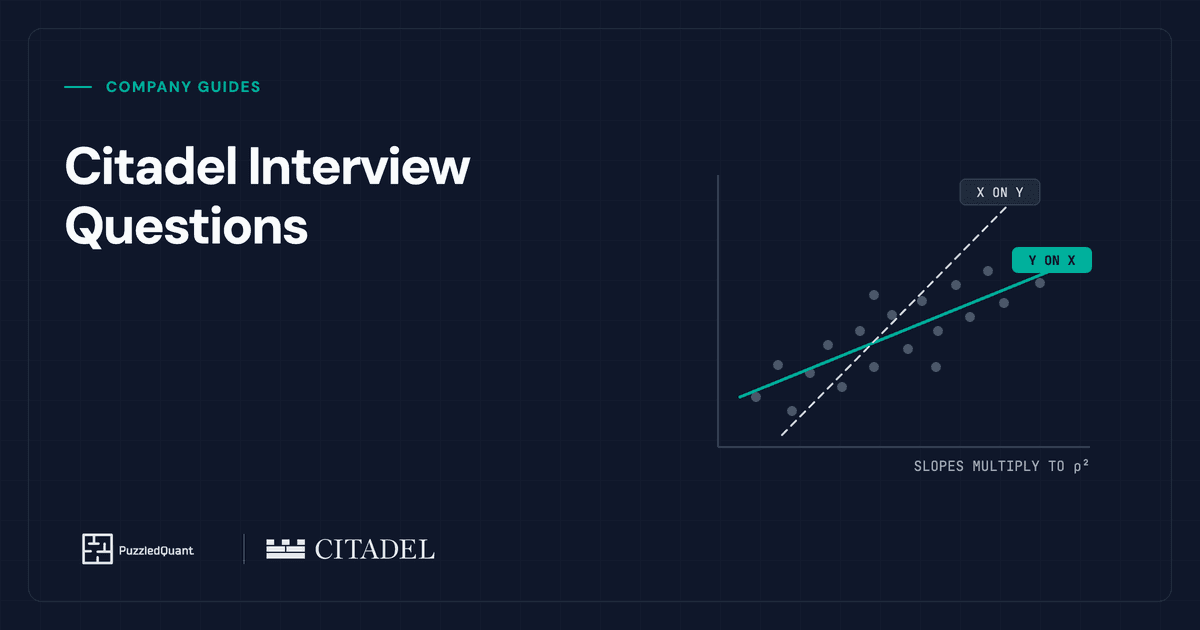
You regress on and get a slope of . Now you regress on . Is the new slope ?
It is tempting to say yes, since that would be true if the points sat exactly on a line. They don't. The least-squares slope of on is
and by symmetry the slope of on is . Multiply the two and the standard deviations cancel:
So the second slope is , which equals only when the correlation is exactly . With noisy data both regressions shrink toward zero, because each one treats the noise in its own target variable as unexplained.
The follow-ups are where the interview happens. Why are the two lines different? (Each minimises vertical distance in its own direction.) If you wanted a line that treats both variables symmetrically, what would you fit? (Total least squares, or the first principal component.) What happens to the slope of on if is measured with noise? (It shrinks toward zero: attenuation bias, which matters a great deal when your signal is noisy.) A candidate who explains why the answer is handles all of these. A candidate who memorised the formula usually gets stuck on the second question.
How to prepare
Decide which business you want. Read both careers sites and be able to explain, in two sentences, why a hedge fund or a market maker suits you. Since you may meet interviewers from both firms, a vague answer gets noticed.
Get your code interview-ready first. Every track starts with code. Work standard data structures and algorithms problems in the language you will interview in until you can write clean, tested solutions while talking. If you are going for a C++ engineering role, our guide to C++ interview questions for HFT covers what low-latency teams ask, and the C++ exercises give you graded practice.
Build statistical intuition, not only puzzle speed. For research roles, work through probability and statistics problems that make you reason about estimators, variance and significance. Our probability interview questions guide and the statistics problems are a good place to start, and expected value questions cover the language trading interviews use.
Practise firm-tagged problems. PuzzledQuant tags problems by the firms known to ask them. Work through the Citadel problems to calibrate difficulty and style, then widen to the top interview questions across firms.
For trading, practise decisions under uncertainty. Betting and sizing questions, quick expected value calculations and market making games all test the "take in new information and act quickly" trait the firm lists. The Dice Market Maker and 80 in 8 cover the two formats candidates most often underprepare.
Prepare a project you can defend. Pick the internship or research project you know best and rehearse explaining it at three levels of detail: one minute, five minutes, and as deep as the interviewer wants to go. Know what you would do differently.
Practise out loud. Both firms say outright that they want to hear your thought process, your trade-offs and what you are unsure of. If you have only ever solved problems in silence, record yourself solving three and listen back.
If you are not sure whether research, trading or engineering suits you, read quant researcher vs trader vs developer before you apply, since both firms prefer you to interview for one role at a time. For the overall plan by role and timeline, start with our complete guide to preparing for quant interviews.
What to do the week before
Ask your recruiter for the structure of your next round: how many interviews, how long, what language, whether it is remote. The firms publish their general process, but your round may differ by team and office.
Then stop learning new material. Re-solve the problems you got wrong in the last two weeks, cold, and rehearse your personal story and your "why this firm" answer until they sound natural rather than recited. If your final round is onsite with three to five back-to-back interviews, do at least one practice block of three mock interviews in a row so you know how your concentration holds up. Our superday guide covers how to handle a full day of interviews.
Citadel and Citadel Securities are demanding interviews, but they are not mysterious. Both firms tell you how the rounds work and what they want to see. Candidates who read that material, write clean code while talking, and can explain their statistics have already done most of the work.
When you are ready, start with the Citadel-tagged problems and see where you stand. Premium unlocks the full problem set and every game, and the pricing page has the details.
Frequently asked questions
Are Citadel and Citadel Securities the same company?
No. Citadel is a hedge fund and Citadel Securities is a market maker, and they are separate firms. For campus engineering and quantitative research they recruit together: you may meet interviewers from both, and Citadel says the campus engineering process is the same for both firms, with placement depending on your skills and each business's needs.
How many rounds are in the Citadel interview process?
Citadel's published campus engineering process has four steps over about eight weeks: a 45-minute video interview, three 45-minute interviews, a leadership interview with a team, and a final review. Citadel Securities' campus quantitative research process typically takes four to five weeks, with a 45 to 60 minute remote first round and an onsite of three to five 60-minute interviews.
What programming language should I use in a Citadel interview?
For campus quantitative research, Citadel Securities says its core languages are Python and C++ but that it welcomes any language. For experienced engineering, most roles let you choose, while some require C++ and you are told in advance. Use the language you are most fluent in unless your recruiter says otherwise.
Do I need finance knowledge to interview at Citadel?
Not for research or engineering roles. Citadel says it can teach you finance but that you should already have strong statistical intuition. Trading roles at Citadel Securities list a passion for markets and an understanding of risk taking under uncertainty, so show genuine interest in how markets work.
How should I prepare for a Citadel quant interview?
Get your coding interview-ready first, since every track starts with code. Then build statistics and probability depth for research, or expected value and decision making for trading. Practise Citadel-tagged problems, prepare one project you can defend in depth, and practise explaining your reasoning out loud, which both firms say they assess.