The Quant Superday: What Happens in the Final Round and How to Prepare
What a quant superday is, how Jane Street, Optiver, SIG, Citadel and HRT run theirs, what each interviewer is scoring, and a two-week plan for the final round.
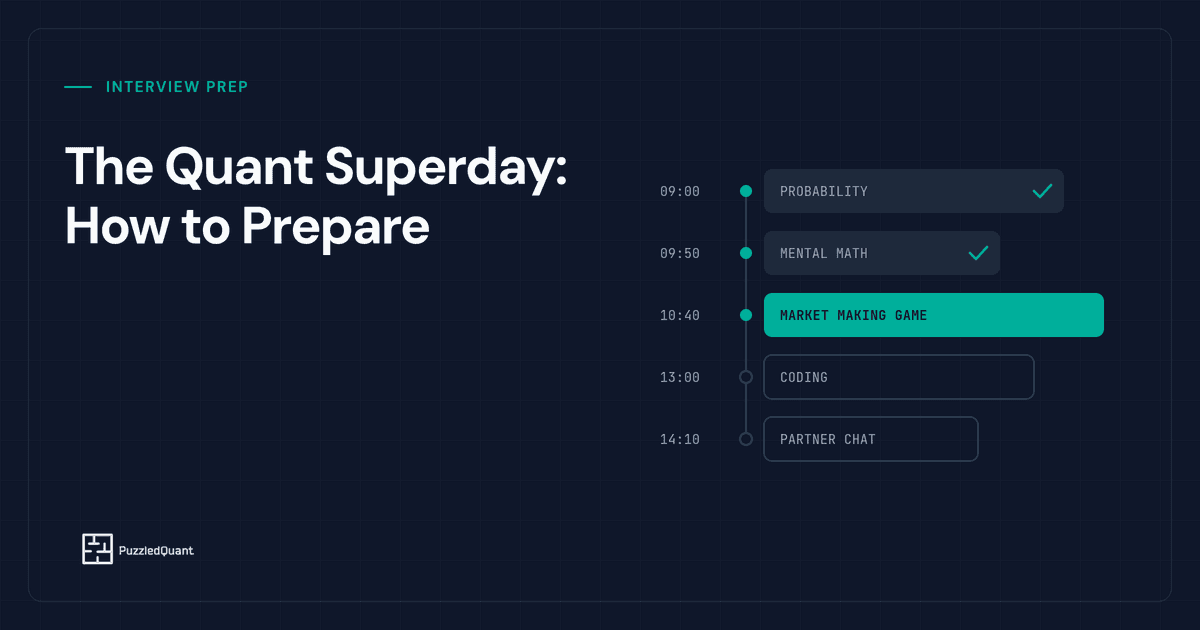
You passed the online assessment. You got through one or two phone screens. Now there is an email with a date and a schedule: four, five, sometimes six interviews in a single day. This is the superday, the final round at almost every quant trading firm and fund, and it is where most offers are won or lost.
It is also the round candidates prepare for worst, because they prepare for it the same way they prepared for the phone screen: more probability problems. The superday is not a harder phone screen. It is testing something different, and the candidates who know what that is have a large edge.
This guide covers what a superday is, how the best-known firms run theirs, what each interviewer is actually scoring, and a two-week plan for the final round.
What a superday is
A quant superday is three to six interviews stacked back to back on one day, onsite or over video, with traders, researchers, engineers and usually one senior person. Each interview is typically 45 to 60 minutes. Interviewers often do not see each other's notes until the end of the day, when they meet in a debrief and decide together.
That debrief is the key to understanding the whole day. You are not being scored interview by interview against a fixed bar. You are being discussed as a whole person by four or five people who each saw a different slice of you. One brilliant interview and three mediocre ones rarely survives that conversation. Four solid interviews and no disasters usually does.
In the US, superdays for summer internships cluster between October and December, with full-time and off-cycle rounds through the year. If you are reading this in the autumn, the timing is not a coincidence.
How the major firms run it
Formats change and vary by role and office, so treat these as the commonly reported shapes, not a script. Your recruiter will tell you the structure of your own day if you ask, and you should ask.
Jane Street. Several interviews in a row, mostly problem solving: probability, expected value and betting games, often built around a single scenario that the interviewer extends as you go. There is usually a market-making or trading-game component, and estimation questions with confidence intervals appear often. Traders are assessed heavily on how they communicate and update; software engineering candidates get a substantial coding component. Our Jane Street interview guide covers the question types in depth.
Optiver. For trading roles, the final day leans on games and simulations: individual trading exercises, sometimes group simulations where several candidates trade together, and mental-math-heavy decision making under time pressure. Candidates often report a final conversation with a senior trader that is less technical and more about judgment and fit, and that it can cut candidates who did well on the technical side.
Susquehanna (SIG). Known for decision making under uncertainty, framed through games: poker-style hands, betting sequences where you are offered wagers and judged on how you size them, and expected value questions where the point is the decision, not the arithmetic. SIG's interest in game theory and bet sizing is well documented in its own educational material.
Citadel and Citadel Securities. Separate businesses with different processes. Candidates commonly describe a series of roughly 45-minute technical interviews covering mathematics and probability, coding (including refactoring or reviewing existing code), and statistics or machine learning for research tracks, alongside behavioral conversations.
Hudson River Trading and other engineering-led firms. For algorithm developer and software roles, the day is closer to a demanding software interview loop: algorithms, systems and low-latency design, C++ depth, and sometimes a short probability question. Our guide to C++ interview questions for HFT covers what they ask.
What each interviewer is actually scoring
On a phone screen the question is "can this person solve problems at our level?" On a superday that question is mostly answered. The new questions are these.
Consistency. Five people see you. If you are sharp in the morning and fall apart at 3pm, that shows up in the debrief as inconsistency, and inconsistency reads as risk. Stamina is a real, trainable part of the day.
How you think when you are stuck. Superday problems are chosen so that most candidates get stuck somewhere. What you do next is the signal: narrate what you have tried, simplify the problem, solve a smaller case, ask a sharp clarifying question. Going silent for three minutes is the worst available option.
How you update. Interviewers will feed you new information mid-problem, push back on a correct answer to see whether you fold, or trade against your quote. They want to see you change your mind by the right amount: not stubbornly, not instantly.
Decision quality under uncertainty. Betting and sizing rounds are not testing whether you can compute an expectation. They are testing whether you take good bets, decline bad ones, and size proportionally to your edge rather than your excitement. A candidate who correctly computes a positive edge and then bets everything has failed the question.
Whether people want to sit next to you. This is not a personality contest. It is whether you are clear, honest about uncertainty, receptive to hints, and pleasant under pressure for eight hours. Desks are small and work is collaborative.
The betting round, done right
Betting and sizing questions are the most superday-specific format and the least practised, so they are worth a closer look.
A typical shape: "I'll roll a die. You can bet on it landing six at 4 to 1. How much of your 100 would you bet?" First, the expectation: you win 4 with probability 1/6 and lose 1 with probability 5/6, so each unit bet loses 1/6 of a unit. The answer is to bet nothing, and to say so plainly. Many candidates bet something anyway because it feels rude to refuse a game.
Change the odds to 6 to 1 and the bet now has a positive edge of 1/6 per unit. How much? Here the interviewer wants to hear that you would not bet everything, and why: ruin. The Kelly criterion gives the growth-optimal fraction as edge divided by odds, here (1/6) ÷ 6, about 2.8% of your bankroll. You do not need to recite Kelly to do well. You need to show that you size bets by edge and risk, that you would bet more when the edge is larger and the outcome less volatile, and that you would never risk ruin for a small edge.
A two-week plan for the final round
Days 1 to 3: map the day. Ask the recruiter for the structure: number of interviews, rough topics, whether there is a game or a coding component, whether it is onsite. Read the firm's own careers pages and any educational material they publish. Build a short list of the formats you will face.
Days 4 to 9: full-length mixed practice. Stop drilling one topic at a time. Do mixed sets of 45 minutes that switch between probability, expected value, estimation and a market or betting question, out loud, as if someone were listening. Filter practice problems to the firm you are interviewing with and work through them in order. Revisit the ones you got wrong two days later; getting a problem right on the second attempt, unprompted, is the only proof you learned it.
Days 10 to 12: stamina. Do two or three back-to-back sessions of four mock interviews with short breaks, as close to the real schedule as you can manage. Notice when your quality drops. That is the hour you need a plan for: food, water, a reset routine between interviews.
Days 13 and 14: taper. Light review of your mistake log, the behavioral stories you will tell, and your questions for each interviewer. Sleep. Superday performance is far more sensitive to sleep than to one more evening of problems.
Prepare the behavioral side properly. Have three or four true stories ready: something hard you solved, a mistake you made and what you changed, a time you disagreed with someone, and why this firm and this role. Keep each to about two minutes. "Why trading?" deserves a real answer, not a rehearsed paragraph about fast-paced environments.
How to practise on PuzzledQuant
The plan above needs three things: problems tagged by firm, a way to work through a shortlist and revisit misses, and practice for the game formats.
- Firm-tagged problems. Problems in the problem bank are tagged with the firms known to ask them, across 39 firms. Filter to the firm on your invitation, for example Optiver, and Next problem now steps through that filtered list rather than the whole bank, so a session stays on target.
- Problem Sets for your shortlist. Make a set called "Superday" or "Optiver final", file problems into it from any problem page with Add to, and work through only that set in the final week. Problem Sets are part of premium.
- Re-drill your misses. Click the solved tick on a problem to mark it as not solved and attempt it again cold. It is the simplest way to test whether you actually learned a problem or just remember its answer.
- Practise the games. The Dice Market Maker has a Make mode where you publish a bid and an ask and trade against both noise flow and informed flow, with a position limit and a breakdown of which fills were adverse, which is about as close to a superday trading exercise as a solo game gets. 80 in 8 keeps arithmetic sharp, and Fermi Estimation trains calibrated intervals.
- The playlist. The Top Interview Questions list collects the problems that come up most across top firms, and is the best single set to finish on in the last few days.
Frequently asked questions
What is a quant superday?
The final round of the interview process at a trading firm or quant fund: three to six interviews back to back on a single day, with traders, researchers, engineers and senior staff. It typically mixes probability and problem solving, trading or betting games, coding for technical roles, and behavioral questions, and the interviewers decide together at the end of the day.
How long is a quant superday?
Usually most of a working day. Expect three to six interviews of 45 to 60 minutes each, with short breaks and sometimes lunch. Some firms split the final round across two days or run it virtually.
What questions are asked in a quant superday?
Probability and expected value problems, often extended across a whole interview; estimation questions with confidence intervals; market-making and betting games; mental math under time pressure; coding and system design for developer roles; and behavioral questions about why you want the role and how you work with others.
How do I prepare for a quant superday in two weeks?
Find out the structure from your recruiter, then spend the first week on mixed, timed, out-loud practice using problems tagged with your target firm, and the second week on stamina (several mock interviews in a row) and behavioral stories. Revisit every problem you missed, and taper with rest before the day.
Do quant firms ask behavioral questions on the superday?
Yes. Most firms include at least one conversation focused on motivation, judgment and how you work with others, and at several firms a final conversation with a senior person carries real weight. Prepare a few honest, specific stories and a genuine answer to "why this firm".