Probability Interview Questions for Quants: 10 Worked Examples
The techniques behind quant probability questions (Bayes, symmetry, complements, recursion, geometric probability, counting) with 10 worked examples.
Probability is the core of the quant interview. Traders get it in the first phone screen, researchers get harder versions of it all the way through, and even quant developer loops usually include a round of it. The good news is that the questions are drawn from a fairly small toolkit. The bad news is that interviewers know that too, so they test whether you pick the right tool fast, not whether you have seen the question.
This guide sets out that toolkit and works through ten probability interview questions, grouped by the technique each one teaches. Our expected value guide covers the "how many on average" questions; this one is about "what are the chances".
The short answer
Most probability interview questions for quants come down to six techniques: conditioning and Bayes' rule, symmetry, complements and disjoint cases, recursion on the first step (for waiting times and races), geometric probability (picture the sample space as an area) and careful counting. You need discrete probability and basic continuous probability. You don't need measure theory, and for most trading interviews you don't need stochastic calculus.
The way to prepare is to learn the techniques, practise graded problems until choosing the technique is automatic, and say your reasoning out loud as you go. PuzzledQuant's probability problems are the largest topic in our bank, with combinatorics, statistics and Markov chains alongside.
The toolkit
| Technique | Reach for it when | Questions below |
|---|---|---|
| Conditioning and Bayes | You are told something happened and asked about something else | 1, 2, 3 |
| Symmetry | Two outcomes are mirror images of each other | 4, 5 |
| Complements and disjoint cases | "At least one", or the event splits into pieces that cannot overlap | 5, 6 |
| First-step recursion | Players take turns, or you wait for a pattern | 6, 7 |
| Geometric probability | Two or more continuous random times or points | 8, 9 |
| Counting | Cards, dice, committees, anything finite and equally likely | 10 |
Before the questions, one habit that saves more points than any formula: write down the sample space. Half of the classic traps (the two-child problem, Monty Hall) only work because the candidate never said what the equally likely outcomes were.
Conditioning and Bayes' rule
1. A positive test
A disease affects 1% of people. A test catches 99% of people who have it, and wrongly flags 5% of people who don't. You test positive. What is the chance you have the disease?
Answer: 1/6, about 17%. Imagine 10,000 people. 100 are sick, and 99 of them test positive. 9,900 are healthy, and 5% of them, 495, also test positive. Of the 594 positives, 99 are sick: .
In formula form, , but in an interview the 10,000-people version is faster to say and harder to get wrong.
What it tests: base rates. A test that is "99% accurate" means little when the condition is rare. Follow-up: you take a second, independent test and it is also positive. Use 1/6 as the new prior and update again: the odds go from 1:5 to , so about 80%.
2. Two children
A family has two children. You learn that at least one is a boy. What is the probability both are boys?
Answer: 1/3. The equally likely families are BB, BG, GB and GG. "At least one boy" rules out GG and leaves three, one of which is BB.
What it tests: whether you condition on exactly what you were told. The variant that catches people: you meet one of the children at random and it is a boy. Now the answer is 1/2, because a BB family is twice as likely to show you a boy as a BG family. The words "at least one" and "a randomly chosen one" describe different events, and interviewers use this pair to check you notice.
3. Two dice, at least one six
You roll two dice and are told at least one shows a six. What is the probability both are sixes?
Answer: 1/11. Of the 36 outcomes, 11 contain at least one six (6 with the first die showing six, 6 with the second, minus the one counted twice). Only one of those 11 is double six.
What it tests: the same conditioning as question 2, with dice. If you answered 1/6, you conditioned on "the first die is a six", which is a different event.
Symmetry
4. One extra coin
Player A flips 11 fair coins and player B flips 10. What is the probability A gets more heads than B?
Answer: exactly 1/2. Set aside A's last coin. After 10 coins each, either A is ahead, B is ahead, or they are tied, and by symmetry A-ahead and B-ahead are equally likely. If A is ahead, A stays ahead. If B is ahead, A can at best tie, so A doesn't win. If they are tied, A wins exactly when the extra coin is heads. Putting those together, A wins with probability where is the chance of being ahead and the chance of a tie, and since , that is .
What it tests: spotting symmetry instead of summing binomial terms. The same answer holds for against coins, for any , which is the follow-up.
5. Three points on a circle
Pick three points independently and uniformly on a circle. What is the probability that all three lie in some semicircle?
Answer: 3/4. Let be the event that the other two points lie in the semicircle going clockwise from point . Each has probability . At most one of these events can happen at once, so the probability of their union is .
What it tests: splitting an event into disjoint, symmetric pieces. The general version for points is , and the interviewer will ask for it once you have done three.
Complements and recursion
6. First to roll a six
A and B take turns rolling a die, A first. The first to roll a six wins. What is the probability A wins?
Answer: 6/11. Let be A's chance. A wins immediately with probability 1/6. Otherwise (5/6), B is now in A's position, so A wins only if B then fails to win from the start, which happens with probability . So , which gives .
What it tests: first-step analysis, where you find a copy of the original problem inside itself. The follow-up: what if B gets two rolls per turn? Same method, different equation.
7. HH before TH
Flip a fair coin repeatedly. What is the probability that the pattern HH appears before the pattern TH?
Answer: 1/4. If the first two flips are HH, HH wins. In every other case TH wins: as soon as a T has appeared, the first H after it completes TH before any HH can form, because an HH would need an H right before it, and that H would itself complete a TH. So HH wins only with the first two flips, .
What it tests: pattern races, a classic family (Penney's game) where intuition is unreliable and a little case analysis is decisive. If you don't see the shortcut, a three-state chain (start, last flip H, last flip T) gives the same answer; the expected value guide shows that method for waiting times.
Continuous and geometric probability
8. Meeting for lunch
Two friends each arrive at a café at a uniformly random time between 12:00 and 1:00. Each waits 15 minutes for the other, then leaves. What is the probability they meet?
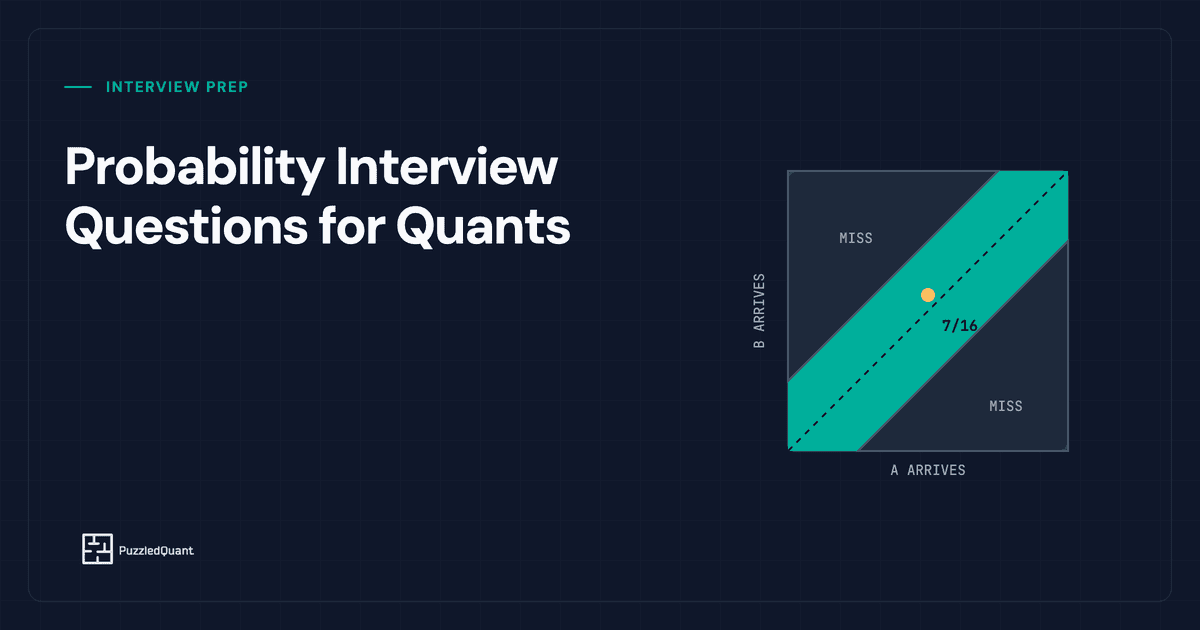
Answer: 7/16. Draw the unit square with A's arrival on one axis and B's on the other. They meet when the arrival times differ by at most 1/4 hour, which is the band around the diagonal. The two corner triangles where they miss each have legs of , so together they have area . The band is .
What it tests: turning two continuous random variables into an area. Candidates who try to integrate first usually take three times as long.
9. The median of three
Draw three independent uniform numbers between 0 and 1. What is the probability that the middle one is less than 1/4?
Answer: 5/32. The middle value is below exactly when at least two of the three are below . That probability is , and at it is .
What it tests: order statistics. The general rule, that the -th smallest of uniforms has density , is worth knowing, but the counting argument above is how you should explain it out loud. Our expected value guide covers the expected maximum, , which comes up just as often.
Counting
10. One pair in poker
You are dealt five cards from a shuffled deck. What is the probability of exactly one pair?
Answer: about 42.3%. Choose the rank of the pair (13 ways) and two of its four suits (). Choose three other ranks from the remaining 12 (), and a suit for each (). That is hands out of .
What it tests: counting without double-counting. The usual mistake is choosing the three side cards one at a time from 48 and forgetting that order doesn't matter, or forgetting that they must not pair with each other. A quick sanity check for card questions: two cards from a deck, what is the chance they share a suit? Condition on the first card: 12 of the remaining 51 match, so .
The mistakes that cost the round
- Answering before naming the sample space. The two-child and dice questions only trap people who skip this.
- Assuming independence that isn't there. Cards drawn without replacement, overlapping patterns in coin flips, and points on a circle are all dependent.
- Reaching for a formula when symmetry is available. If the question has a mirror image, look for it before summing anything.
- Going quiet. Interviewers grade the path. If you are setting up an equation, say what each term means.
- No sanity check. A probability above 1, or an answer that doesn't change when a parameter obviously should matter, is something you can catch in five seconds.
How to practise
Learn the toolkit from one good source. The probability chapters of Xinfeng Zhou's A Practical Guide to Quantitative Finance Interviews (the green book) are the standard reference, and Jane Street's free Probability and Markets guide is written by people who interview candidates. Our review of the best quant interview books covers what each book is good for.
Do graded, timed problems. Reading a solution and nodding is not practice. PuzzledQuant's probability, expected value and combinatorics collections take your answer and check it, with a hint if you are stuck and a written solution after. Many problems are tagged with the firms known to ask them, so you can also work through, for example, the Jane Street or Optiver sets. A large share of the bank is free; Premium unlocks the rest.
Mix in the neighbours. Probability questions rarely come alone. Expect brainteasers and expected value in the same interview, and a market making game later on that is really probability under time pressure. The Card Counting game trains exactly that: updating a probability as cards are revealed.
Build a schedule. If you are not sure how probability fits with the other rounds, our complete guide to preparing for quant interviews lays out 4, 8 and 12-week plans by role.
Frequently asked questions
What probability topics come up in quant interviews?
Conditional probability and Bayes' rule, symmetry arguments, complements, first-step recursion for races and waiting times, geometric probability with uniform random variables, order statistics, and combinatorial counting with cards and dice. Research roles add more statistics and continuous distributions, but the discrete core is the same for every role.
How hard are quant probability interview questions?
The mathematics is undergraduate level. The difficulty is speed and accuracy under pressure, choosing the right technique quickly, and explaining it clearly while the interviewer changes the question. Most candidates who struggle know the material but have not practised doing it out loud against a clock.
Do I need to know stochastic calculus for a quant trading interview?
Usually not. Trading interviews focus on discrete probability, expected value and mental math. Some quant research and derivatives pricing roles go further, but for most first rounds solid discrete probability is worth far more than stochastic calculus.
How should I answer a probability question I have not seen before?
Write down the sample space, look for symmetry, try a small case, and say each step out loud. If you get stuck, explain what you tried and why it fails, then take the hint. Interviewers score your process, and a clear partial answer often beats a silent correct one.
Where can I practise quant probability questions?
PuzzledQuant has a large bank of graded probability problems, many tagged by the firms that ask them, plus expected value, combinatorics and statistics collections. The green book and Jane Street's free Probability and Markets guide are good companions for theory and worked examples.