The Best Quant Interview Books, Reviewed: Green Book, Heard on the Street, Red Book and Mosteller
What is actually inside the green book, Heard on the Street, the red book, Fifty Challenging Problems and the rest, where each one falls short, and how to fit them into a prep plan.
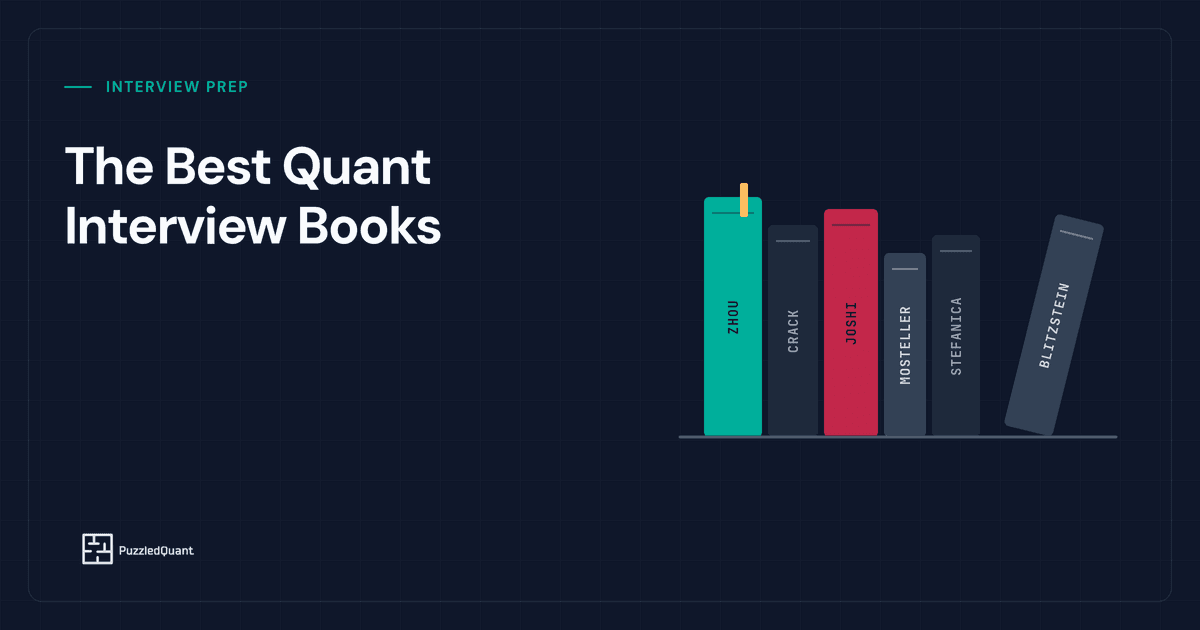
Ask anyone who got a quant offer how they prepared, and a book comes up within two sentences. Usually it is green. The quant interview has a short canon: a handful of books that almost every candidate reads, that interviewers know are being read, and that between them account for a surprising share of the questions asked in real rounds.
They are also old, uneven, and easy to use badly. This is a straight review of the books that matter: what is actually inside each one, what it does well, where it falls short, and how to fit it into a prep plan without spending three months reading when you should be solving.
The short version
| Book | Best for | Strength | Main weakness |
|---|---|---|---|
| A Practical Guide to Quantitative Finance Interviews (Zhou), "the green book" | Everyone, first | The canonical problems, rigorous solutions | Terse; predates modern formats |
| Heard on the Street (Crack) | Trading and finance breadth | Widest coverage, interviewer's perspective | Lighter on hard maths; some dated questions |
| Quant Job Interview Questions and Answers (Joshi, Denson, Downes), "the red book" | Derivatives quants, quant developers | Depth on pricing, numerics and C++ | Dense, specialised, sell-side flavour |
| Fifty Challenging Problems in Probability (Mosteller) | Probability intuition | Elegant classics, many still asked | Loose, dated wording; not a curriculum |
| 150 Most Frequently Asked Questions on Quant Interviews (Stefanica, Radoicic, Wang) | Researchers, final review | Compact, recent second edition | Narrow; little explanation |
| Introduction to Probability (Blitzstein, Hwang) | Foundations | The best teacher of the bunch | A textbook, not interview prep |
The green book: A Practical Guide to Quantitative Finance Interviews
Xinfeng Zhou's book, published in 2008, is the default first book for good reason. It is organised into seven chapters: general problem-solving principles, brain teasers, calculus and linear algebra, probability theory, stochastic processes and stochastic calculus, finance, and algorithms and numerical methods. Across them sit a couple of hundred problems, most of them the canonical forms of questions that still come up in interviews today.
What it does well. The selection. If a probability puzzle is famous in quant interviews, the green book probably has it: the drunk man on the cliff, the ant on a cube, dice games with stopping rules, the expected number of coin tosses to reach a pattern. The brain teasers chapter and the probability chapter are the two highest-yield chapters in any interview book, and the stochastic processes chapter, with Markov chains, martingales and Brownian motion, is excellent preparation for research roles. Solutions are mathematically careful and usually show a reusable technique rather than a trick.
Where it falls short. Three ways.
- The solutions are terse. Zhou writes for a reader who already almost knows the answer. When you are stuck, a two-line solution can leave you as stuck as before, and that is where most candidates either copy the answer into their memory without understanding it, or give up on the chapter.
- It predates the modern process. In 2008 the timed online assessment, the 80-in-8 arithmetic test and the structured market-making game were not the gatekeepers they are now. The book says little about mental math speed, nothing about sequence tests, and little about making markets. The finance chapter reflects the derivatives-desk interview of its era.
- Everyone has read it. Interviewers know which problems are in the green book. They change the numbers, flip the condition, or extend the question one step past where the book stops. Memorising the book's answers is close to useless. Understanding its methods is not.
How to use it. Read chapter 1 once. Work chapters 2 and 4 properly: attempt every problem for at least ten minutes before reading the solution, and redo the ones you missed a week later. Do chapter 5 if you are targeting research roles or a firm that likes Markov chains. Skim chapter 6 unless you are interviewing for a derivatives role.
Heard on the Street
Timothy Falcon Crack's book was first self-published in the mid-1990s and has been revised continually since, now well past its twentieth edition, with recent editions carrying more than 240 quantitative questions alongside non-quantitative ones. Crack collected the questions from real interviews and writes from the perspective of what the interviewer is looking for.
What it does well. Breadth. Logic puzzles, probability and statistics, financial economics, options and derivatives, and a section on non-quantitative questions that most interview books ignore. It is the best book for getting used to the full range of things that can come up, and the solutions are more discursive than Zhou's, so they help more when you are stuck.
Where it falls short. It is lighter than the green book on the mathematics that research interviews lean on, and some questions come from an investment-banking era of quant hiring that looks less like a modern prop-shop loop. Pick and choose.
How to use it. As the second book, for breadth after the green book's core. It is especially useful for trading candidates and anyone interviewing at a bank or asset manager, where the financial-economics questions are more likely.
The red book: Quant Job Interview Questions and Answers
Mark Joshi, Nick Denson and Andrew Downes wrote this from the perspective of practitioners who had interviewed on both sides of the desk. The second edition carries more than 300 questions with full solutions, discussion of what the interviewer is looking for, and likely follow-ups. Topics include option pricing, probability, mathematics, numerical methods and C++, plus the interview process itself.
What it does well. Depth on derivatives. If you are interviewing for a pricing or desk-quant role, a structuring role, or a quant developer role at a bank, nothing else covers stochastic calculus, risk-neutral pricing, numerical methods and the C++ side of the job in interview form like this. The follow-up questions are realistic: this is how a pricing quant actually extends a question.
Where it falls short. It is dense, hard and specialised, and its centre of gravity is the sell-side derivatives quant. A candidate aiming at a market-making firm's trader role will find much of it beside the point. Formatting is less polished than the green book's.
How to use it. Only after the core, and only if your target role is derivatives-heavy or a developer role that tests C++ and numerics together.
Fifty Challenging Problems in Probability
Frederick Mosteller's little book was first published in 1965 and has been a Dover paperback since 1987. Despite the title, it contains 56 problems, with full solutions. It is cheap, short, and quietly the source of a remarkable number of interview questions: the sock drawer, successive wins, the birthday problem and its relatives, coupon collecting, gambler's ruin, the three-cornered duel, choosing the largest dowry (the secretary problem), the locomotive problem, the broken bar, and Buffon's needle.
What it does well. Each problem is chosen to teach one idea elegantly, and Mosteller's solutions explain why, not just what. Working through it builds exactly the probabilistic intuition interviews reward: symmetry arguments, conditioning on the first step, and spotting when a problem is simpler than it looks.
Where it falls short. It is sixty years old and reads like it. Some problems are loosely worded by modern standards, a few lean towards statistics rather than interview probability, and there is no structure beyond the sequence of problems. It will not teach you a market-making game or prepare you for a timed test.
How to use it. Alongside the green book's probability chapter, as a second pass on the same ideas from a different angle. Do all 56 if you have the time; it is a weekend's work for a strong candidate.
The rest of the shelf
150 Most Frequently Asked Questions on Quant Interviews by Dan Stefanica, Rados Radoicic and Tai-Ho Wang, second edition 2019. A compact set covering probability, calculus, stochastic calculus and finance, with brief solutions. Good as a final review for research candidates, less good as a first book.
Introduction to Probability by Joe Blitzstein and Jessica Hwang, from Harvard's Stat 110. Not an interview book, but the best teacher of the underlying ideas, and the book (along with the course's lectures) is freely available online. When a green book solution makes no sense, the reason is usually a gap that Blitzstein fills.
Role-specific additions. Options trading candidates should know Option Volatility and Pricing by Sheldon Natenberg, the standard practitioner text. Paul Wilmott's Frequently Asked Questions in Quantitative Finance gives a conversational overview of the models and their debates. For mental math, Secrets of Mental Math by Arthur Benjamin and Michael Shermer teaches the techniques, though only timed practice builds the speed.
How to fit the books into your prep
A reading list is not a plan. Here is one that works for most trader and researcher candidates over eight to ten weeks. (For the whole loop, not only the reading, see how to prepare for quant interviews.)
- Foundations, as needed (weeks 1 to 2). If conditional probability, expectation and common distributions are shaky, work the relevant Blitzstein chapters first. They are free, along with the rest of our free quant interview prep resources. Skip what you already know.
- The core (weeks 2 to 5). Green book chapters 2 and 4, then Mosteller. Our quant brainteasers and probability interview questions work through the techniques those chapters drill. Attempt before reading. Keep a log of every problem you could not solve, and of the technique the solution used.
- Breadth (weeks 5 to 7). Heard on the Street, selectively, focused on the sections closest to your target role. Research candidates add green book chapter 5. Derivatives candidates start the red book.
- Convert reading into performance (weeks 6 to 10). This is the stage books cannot do for you. Timed problems, out loud, mixed across topics, with your answers actually checked, plus the game formats: mental math tests, market making, estimation.
Two rules apply throughout. First, never read a solution until you have a written attempt, even a wrong one. Recognising a solution and producing one are different skills, and the interview tests only the second. Second, after you solve a problem, change it: a different number of dice, a biased coin, three heads instead of two. If your method breaks, you memorised an answer rather than learned a technique.
Where the books stop
Every book on this list has the same limits, because they are books.
- They cannot check your answer without you reading the solution, which ends the problem.
- They are not timed. An interview problem has a clock and a listener. A book has neither.
- They are static and widely read. The same problems, in the same words, that the interviewer knows you have seen.
- They cannot simulate a game. No book can trade against your quote.
- They do not know which firm asks what.
That is the gap we built PuzzledQuant to fill. The problem bank has 1,160+ problems across probability, expected value, brain teasers, combinatorics, Markov chains, game theory and more, with answers graded the moment you submit, tagged by the firms known to ask them, and filterable by topic, difficulty and firm. A few ways it fits alongside the books:
- Graded practice of the same ideas. Work green book chapter 4, then filter the bank to Probability or Expected Value and solve problems you have not seen, with your answer checked. This is the test of whether the chapter stuck.
- Problem Sets as your log. Make a set for "missed, revisit" and file every problem you could not solve into it, then clear the set a week later. Click the solved tick on a problem to mark it as not solved and attempt it cold again.
- Walkthroughs when the solution is too terse. A growing number of problems have a solution video, available on premium, that explains the reasoning step by step, which is precisely what the green book's two-line solutions do not.
- The formats books cannot do. The games cover mental math tests, market making, sequences and Fermi estimation, the parts of the modern process that no book from 2008 anticipated.
- An AI tutor that knows your history. Connect Claude or ChatGPT to PuzzledQuant over MCP and ask it to pull problems on the topics you have covered least, or similar problems to one you just missed.
Read the books. They are the canon for a reason. Then make sure you can do, under a clock and with your answers checked, what they taught you.
Frequently asked questions
What is the green book for quant interviews?
A Practical Guide to Quantitative Finance Interviews by Xinfeng Zhou, published in 2008 and nicknamed for its green cover. It covers brain teasers, calculus and linear algebra, probability, stochastic calculus, finance and algorithms through a couple of hundred interview-style problems, and is the most widely recommended first book for quant trader and researcher interviews.
Is the green book enough to pass quant interviews?
Rarely on its own. Its probability and brain teaser chapters cover the core of what is asked, but it predates timed online assessments, mental math tests and structured market-making games, and its solutions are terse. Most successful candidates pair it with a second book for breadth and a lot of timed, graded practice on problems they have not seen.
Is Heard on the Street still worth reading?
Yes, as a second book. Timothy Crack has kept revising it for decades, and it offers the broadest coverage of any interview book, including financial economics and non-quantitative questions. It is lighter on advanced maths than the green book, and some questions reflect older investment-banking interviews, so read it selectively.
What is the red book in quant finance?
Quant Job Interview Questions and Answers by Mark Joshi, Nick Denson and Andrew Downes, with more than 300 questions in its second edition. It goes deep on derivatives pricing, stochastic calculus, numerical methods and C++, and suits desk-quant, pricing and quant developer roles more than trading roles at market-making firms.
Is Fifty Challenging Problems in Probability good for quant interviews?
Yes. Mosteller's 56 problems include many interview classics, such as the birthday problem, gambler's ruin, coupon collecting and the secretary problem, and the solutions teach reusable reasoning. The wording is dated and it is not structured as interview prep, so use it alongside the green book's probability chapter.
In what order should I read quant interview books?
Fill foundation gaps first, with a textbook such as Blitzstein and Hwang if needed. Then the green book's brain teaser and probability chapters, then Mosteller, then Heard on the Street for breadth. Add the red book only for derivatives or quant developer roles. Spend the final weeks on timed, graded practice rather than more reading.