Fermi Estimation Questions in Quant Interviews: How to Answer and Calibrate
How trading firms use Fermi questions, a five-step method for decomposing any estimate, two worked examples, and why your confidence interval matters more than your number.
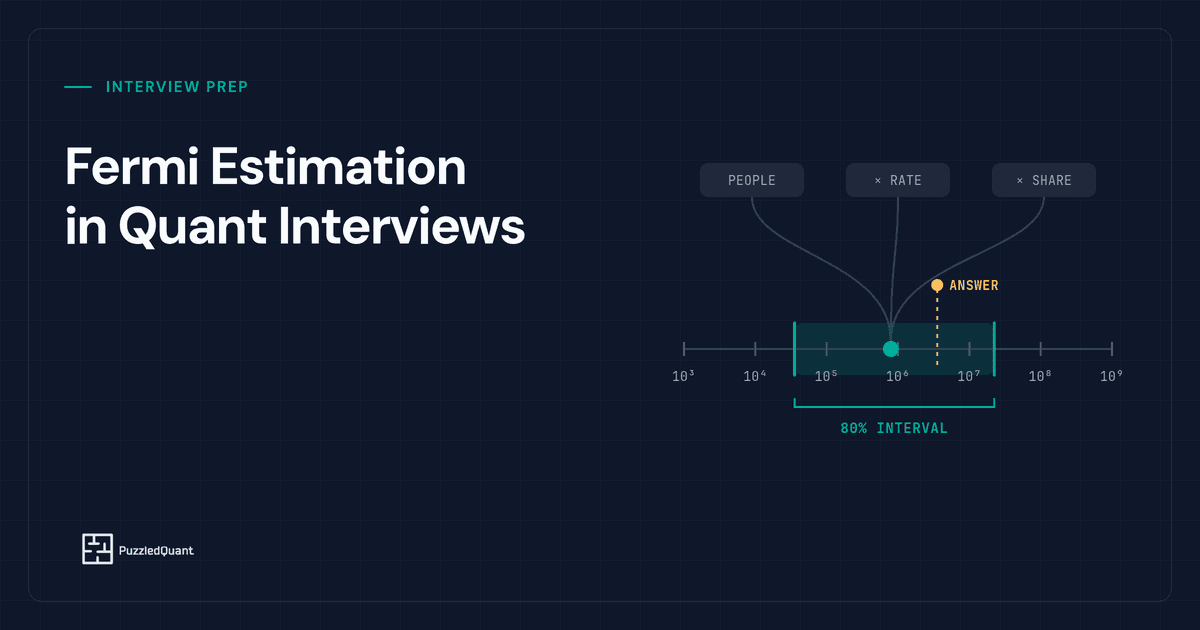
"How many piano tuners are there in Chicago?" is the most famous interview question nobody can answer. That is the point. Nobody expects you to know. The interviewer wants to watch you build a number out of things you do know, say how sure you are, and defend it when they push.
Trading firms ask these questions for a reason that has nothing to do with pianos. A trader's whole job is putting prices on things that cannot be looked up: what a contract is worth thirty seconds after a headline, how large the order behind a print probably is, how many shares will trade in the closing auction. A Fermi question is that skill, stripped of finance, under observation.
This guide covers where these questions appear, a method that works on any of them, two worked examples, and the part almost every candidate gets wrong: the confidence interval.
Where Fermi questions show up
They appear at nearly every trading firm, usually in a phone screen or on the superday, and rarely as a standalone round. The common shapes:
- The plain estimate. "Estimate the number of commercial flights in the air right now." You give a number and your reasoning.
- Estimate plus interval. You give a point estimate, then a range you are 80% or 90% sure contains the truth. This is the version that matters, and the one this guide is built around.
- Estimate as a market. "Make me a market on the number of golf balls that fit in this room." Your interval becomes a bid and an ask, and the interviewer buys or sells against you. Jane Street, Optiver and Susquehanna (SIG) all run variants of this, often folded into a market making game.
- Estimate then bet. You give a 90% interval, and the interviewer offers you a bet at odds that only make sense if your interval is honest. If you said 90% and you would not take a bet at 9 to 1 that the truth is inside, your interval was not 90%.
The last two are the real test. Anyone can multiply some numbers. The skill being priced is whether your stated confidence means anything.
The method, in five steps
1. Restate the quantity and pin the units. "Commercial flights in the air right now" is a count at an instant, not a daily total. Half of all Fermi mistakes are answering a slightly different question. Say the definition out loud so the interviewer can correct you before you spend three minutes on the wrong thing.
2. Decompose into factors you can estimate. Choose a chain where each link is something you have a feel for. Population × share who do the thing × how often they do it × how long it takes. Two or three factors is usually right. Seven factors means seven chances for an error to compound.
3. Estimate each factor in orders of magnitude. You do not need 7.4 million. You need "between 5 and 10 million, call it 7." When a factor is genuinely uncertain, take the geometric mean of a low and high bound you believe: if a quantity is somewhere between 10 and 1,000, your central guess is 100, not 505. Fermi problems live on a log scale, and arithmetic means on a log scale are a classic way to be off by a factor of five.
4. Multiply, then sanity-check from a second direction. Reach the same number by a different decomposition, or compare it to a fact you know. If your estimate says there are 40 million dentists in the US, something upstream is wrong. The second path is the single most impressive thing you can do in a Fermi round, because it shows you distrust your own number.
5. State your interval and what would move it. "My point estimate is 6,000. I would put 80% on 2,000 to 20,000. The widest uncertainty is in how long a flight lasts on average, and if you told me that, my range would halve." That last sentence is what separates a trader's answer from a student's.
Worked example one: flights in the air
How many commercial passenger flights are in the air at this moment?
Restate: a count at an instant, worldwide, scheduled passenger flights.
Decompose: (flights per day worldwide) × (average flight duration ÷ 24 hours). That is Little's law, the same identity that tells you the size of a queue from its arrival rate and wait time, and it is worth having in your pocket because it turns a lot of "how many right now" questions into "how many per day" questions, which are easier.
Flights per day: a big airport handles on the order of 1,000 departures a day. There are perhaps 50 to 100 airports that size and thousands of smaller ones. Rather than add up airports, go through passengers: around 4 to 5 billion passenger journeys a year is a figure many people remember, which is roughly 12 million a day. At around 120 passengers a flight, that is about 100,000 flights a day.
Duration: most flights are short-haul. Call the average two hours, so a flight is airborne for 2/24, about a twelfth of the day.
Multiply: 100,000 × 1/12 ≈ 8,000 flights in the air at once.
Check from another direction: flight-tracking maps at a busy hour show something like ten thousand aircraft, and that includes cargo and private flights, so 8,000 for commercial passenger traffic is in the right neighbourhood. An 80% interval of 4,000 to 15,000 is honest: the factors are each good to within about 50%, and on a log scale those uncertainties add.
Worked example two: why your interval is the answer
Here is the same idea from the interviewer's side. Ask three candidates how many times a human heart beats in a lifetime, and ask each for an 80% range.
Worked example: scoring an 80% range
The answer is about 3 billion: 70 beats a minute, 60 minutes, 24 hours, 365 days, 80 years. The first candidate's range of 1 to 6 billion contains it and is narrow, so it carries real information. The second candidate said 10 million to 100 billion. That also contains the truth, but a range spanning four orders of magnitude tells a trader nothing they can act on. The third was confident and tight at 20 to 100 million, and missed by a factor of thirty.
Most candidates assume the second answer is the safe one. It is not. In a market-making framing, a range that wide is a bid of 10 million and an offer of 100 billion: no one will ever trade with you, and the interviewer will tell you so. In a betting framing, an interval that always contains the answer is evidence that you are not using the information you have.
Calibration is the actual skill
Calibration means your 80% intervals contain the truth about 80% of the time. Not 100%, which means you are padding, and not 40%, which means you are overconfident. Overconfidence is the common failure by a wide margin. Studies of interval estimates going back decades find that people asked for 90% intervals typically capture the truth only about half the time.
There is a precise way to grade this. A proper scoring rule is a score that you maximise in expectation only by reporting what you actually believe. The log score is the standard one: you treat your interval as a probability distribution, and you are scored by how much probability that distribution puts on the true answer. A tight interval around the truth puts a lot of probability there and scores well. A wide interval spreads probability thin and scores poorly even when it is "right". A tight interval in the wrong place puts almost no probability on the answer and scores catastrophically, because the log of a tiny number is a large negative one.
That asymmetry is exactly the behaviour an interviewer is checking for, and it is why the honest strategy and the high-scoring strategy are the same strategy. Shading your interval narrower to look sharp, or wider to look safe, both lose.
Three habits help:
- Track your hit rate. Do twenty estimation questions with 80% intervals and count how many contain the answer. If it is twelve, widen. If it is twenty, tighten.
- Widen on the factor you are least sure of, not everywhere. Uncertainty is not uniform across a decomposition. Name the weakest link and put your width there.
- Work in log space. A range from 2,000 to 20,000 is symmetric around 6,300, not 11,000. Say your point estimate as the geometric centre of your range.
Mistakes that cost the round
- Silent multiplication. Fermi rounds are graded on the narration. A correct number with no visible reasoning scores worse than a slightly off number with a clean decomposition.
- False precision. "4,312" tells the interviewer you do not understand what you just did. Round to one or two significant figures.
- Too many factors. Every factor adds error. Find the shortest chain you trust.
- Defending a number instead of updating it. When the interviewer says "that seems high", they may be testing whether you fold or whether you reason. Ask which factor they doubt, reconsider that factor, and move only as much as the new information justifies.
- Forgetting the interval. If they did not ask for one, offer one anyway. It costs five seconds and signals exactly the instinct they are hiring for.
How to practise
Fermi skill improves quickly with repetition and feedback, and slowly without feedback. You need to see the true answer after every guess, and you need it often enough that calibration becomes a habit rather than a thing you remember to do.
We built two tools on PuzzledQuant for exactly that.
Daily Fermi is one estimation question a day, the same for everyone, playable from the home page. You type a guess, see the answer, see where you rank among everyone who played today and how the whole field guessed, and share your result. Scoring is on a log scale: an exact guess earns 1,000 points, being off by a factor of ten earns 500, and being a hundred times off earns nothing. It takes two minutes, and the daily cadence is what builds the habit.
Fermi Estimation is the interval version, and the closer match to the interview. Each run is ten questions across three difficulties, and you answer every one with an 80% range, not a number. Your range is scored as a probability distribution with a log score, the proper scoring rule described above, so a tight range around the truth pays the most, a lazy "one to a trillion" is worth nothing, and a confident miss is punished hard. Time left on the clock adds a small bonus, but only in proportion to how well the round went, so rushing a vague range does not pay.
Pair them with the estimation-flavoured problems in the problem bank, and with the market making games, which turn the same interval into a bid and an ask under pressure.
Frequently asked questions
What is a Fermi estimation question?
A question that asks you to estimate a quantity you cannot look up, such as the number of piano tuners in Chicago, by breaking it into smaller factors you can reason about and multiplying them. Interviewers grade the decomposition, your sanity checks, and how well your stated confidence matches your accuracy, more than the final number.
Which firms ask Fermi questions?
Most trading firms use them, usually in a phone screen or on the superday rather than as a dedicated round. Jane Street is known for asking for an estimate and a confidence interval and then betting against the interval. Optiver and SIG often fold estimation into market-making exercises. Consulting firms use the same format as "market sizing".
How wide should my confidence interval be?
Wide enough that it contains the truth as often as you claim. An 80% interval should miss about one time in five. Most people are overconfident, so if you have never measured your hit rate, your intervals are probably too narrow. Practise with feedback and adjust until your hit rate matches the level you are stating.
Is it better to give a wide interval to be safe?
No. A very wide interval contains the answer but carries no information, and under a proper scoring rule such as the log score it scores close to nothing. In a market-making version of the question, a wide interval is a market nobody will trade on. The best score comes from an interval that is as narrow as your knowledge honestly allows.
How can I practise Fermi questions?
Do several a week with immediate feedback on the true answer, and track how often your intervals contain it. PuzzledQuant's Daily Fermi gives you one question a day on a log-scale score, and the Fermi Estimation game scores full 80% intervals as probability distributions, which is the closest practice to the interview format.