QuantGuide Alternatives: PuzzledQuant vs QuantGuide and More (2026)
What QuantGuide does well, where it stops, a head-to-head with PuzzledQuant, and the best alternatives for probability volume, developer prep and free practice.
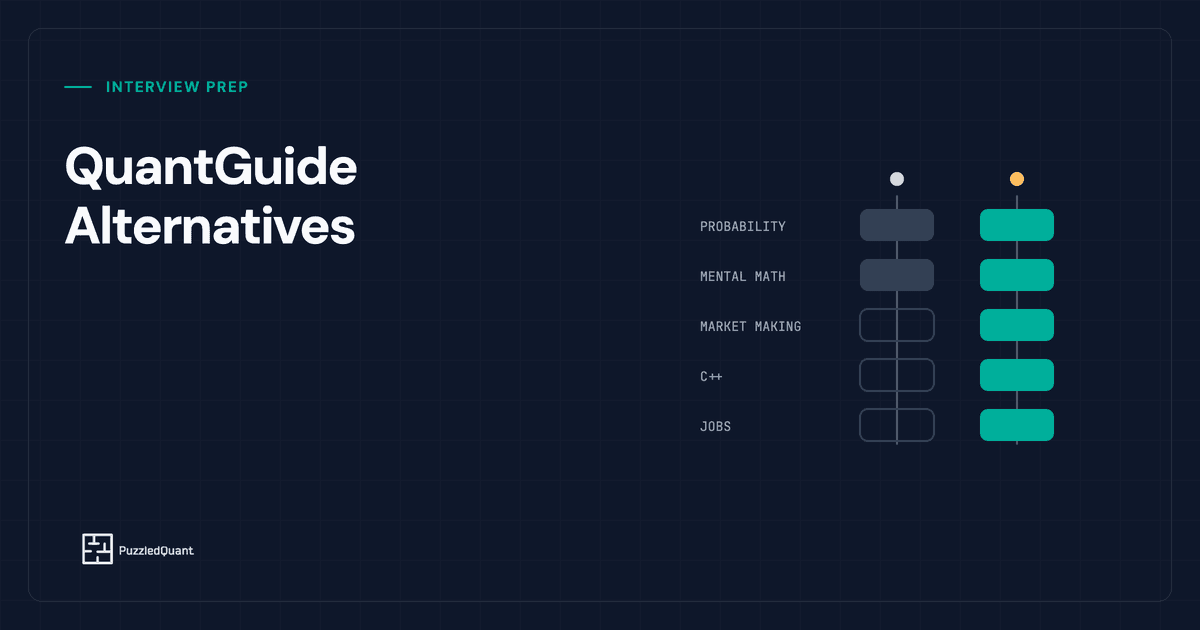
If you have prepared for a quant interview in the last few years, you have probably used QuantGuide. It is a good question bank, and for a lot of candidates it was the first quant-specific site they paid for. The question we hear most often is the follow-up: is QuantGuide enough, and if not, what should sit next to it or replace it?
This post answers that from QuantGuide's side of the table. We checked QuantGuide's public pages and every alternative below in October 2026, so the prices and counts are as of then. We make one of the alternatives, PuzzledQuant, so read our comparison with that in mind. Every figure about another site comes from that site's own public pages, and you can check them yourself.
The short answer
- If you want one platform for the whole interview loop: PuzzledQuant. It has graded problems tagged by 45 firms, seven market making and mental math games, C++ and OCaml exercises, a job board and a free tier. It costs $150 a year against QuantGuide's $240.
- If you want more probability volume than QuantGuide: QuantVault claims 3,200+ problems, with a deeper statistics and stochastic calculus slant.
- If you are a quant developer: getcracked for systems depth, or PuzzledQuant's C++ exercises plus LeetCode.
- If an online assessment is days away: TraderMath for firm-style numerical tests, or PuzzledQuant's 80 in 8.
- If you have no budget: PuzzledQuant's free tier, QuantGuide's free tier, Brainstellar, Zetamac and Jane Street's free guide.
Our ranking of the whole market is in the best quant interview prep platforms. This post is narrower: it is for people who already know QuantGuide.
What QuantGuide does well
Start with why QuantGuide is popular, because that is what you would lose by leaving it.
A large, focused bank. QuantGuide's question list showed 1,211 questions in October 2026. By its own skill breakdown, 733 are probability, 246 brainteasers, 96 finance, 76 statistics and 60 pure math, with machine learning marked "coming soon". If your interviews are mostly probability and brainteasers, that is a lot of reps in the right area.
Every question has a hint and a full solution. The pricing page says premium unlocks "detailed solutions and hints to every question on the platform (1,000+)". The interface works like LeetCode: filter by topic, difficulty and status, and track progress.
Strong company tags for some firms. The question list shows company counts, led by SIG (146), Jane Street (133), Citadel (84), Goldman Sachs (72) and Five Rings (70). Company search is a premium feature. If you are interviewing at SIG or Five Rings in particular, QuantGuide tags more questions for those firms than we do.
Curated playlists. "Quant Trader 75" and "Top 50" give you a sensible order to work in, which matters when a bank has more than a thousand questions.
A mental math simulator. Quantify, QuantGuide's arithmetic game, is included on the free plan.
Where QuantGuide stops
None of these are flaws in what QuantGuide sets out to do. They are rounds of the interview it does not try to cover.
- No market making practice. Trading interviews at most prop firms include a round where you quote a bid and an ask and update as you trade. QuantGuide has finance questions, but no interactive market making game.
- One game. Quantify trains arithmetic. There is nothing for sequence tests, betting and sizing, or estimation with confidence intervals.
- No developer track. The skill list has no coding or C++ category. Quant developer candidates need a second resource for C++, systems and algorithms.
- No careers side. There is a discussion forum, but no job board, no resume library and no resume review.
- The yearly price. The annual plan is $20 a month, billed as one $240 payment. Monthly is $35.
PuzzledQuant vs QuantGuide
Here is the head-to-head, from each site's public pages in October 2026.
| PuzzledQuant | QuantGuide | |
|---|---|---|
| Question bank | 1,160+ graded problems | 1,211 questions |
| Topics | Probability, expected value, brainteasers, combinatorics, statistics, Markov chains, game theory, C++ and more | Probability, brainteasers, finance, statistics, pure math |
| Solutions | Written solution and hint on every problem, video walkthroughs on selected ones | Hint and detailed solution on every question |
| Firm tags | 45 firms | Company tags (premium) |
| Games | 7: 80 in 8, Arithmatic Mania, Dice Market Maker, Card Counting, Fermi Estimation, Find Next in Sequence, Pump Up The Balloon | Quantify (mental math) |
| Developer prep | C++ and OCaml exercises | None listed |
| Job board | Yes | No |
| AI assistant integration | MCP server for ChatGPT, Claude, Cursor and VS Code | No |
| Free tier | 560+ problems, question of the day, sample exercises | Non-premium questions, analytics, Quantify |
| Price | $35/mo, $60/quarter, $150/yr | $35/mo, or $240/yr ($20/mo) |
The two sites price their monthly plans identically, so the difference shows up over a full prep season. Say you prepare for three to six months. On PuzzledQuant that is $60 for one quarter or $150 for a year. On QuantGuide it is $105 for three months, or $240 for the year.
Firm coverage is where the two really differ, and neither covers the other. QuantGuide's largest tags are US firms, with SIG at the top. Ours are led by Jane Street, alongside India-based HFT firms such as AlphaGrep, Quadeye and Graviton, plus Citadel, Optiver, HRT and others. Before you pay for either site, check the firm list against the firms you are actually applying to.
Which one should you pick?
Pick PuzzledQuant if you want one subscription that covers every round. That means the probability and brainteaser questions QuantGuide is known for, plus the market making round, the arithmetic screen and, for developers, C++. It is also the cheaper choice for a season of prep.
Stay on QuantGuide if your loop is almost entirely probability and brainteasers, you are targeting SIG or Five Rings specifically, and you already have the other rounds covered elsewhere.
Use both if you have a few months and want maximum probability volume. Plenty of candidates do this. If you do, use QuantGuide for extra reps and PuzzledQuant for the rounds QuantGuide skips: market making games, 80 in 8 and the C++ exercises.
Other QuantGuide alternatives, by what you need
More problems: QuantVault
QuantVault is the newest of the large banks. In October 2026 it listed 3,200+ problems, about 400 of them free, along with 47 company funnels, 19 trading games and 40+ courses. Its pitch is depth in statistics, regression, stochastic calculus and time series, which suits quant researcher candidates. Pricing is $24 a month, $59 a quarter or $169 a year, as listed on its pricing page. The bank size is a claim we cannot independently verify, and the site is young. Still, if raw volume is what you want after QuantGuide, this is the obvious place to look.
Developer depth: getcracked
getcracked started as quant developer prep and is strongest on C++, concurrency, memory and low-latency systems, with a busy Discord. Its pricing page in October 2026 listed yearly plans by discipline: hardware engineering at $201, trading at $271, development at $330, and a top plan at $390. Every plan costs more than PuzzledQuant's $150 a year, and all but the hardware plan cost more than QuantGuide's $240. A Reddit thread from January 2026 reports that it moved from a free tier to a trial-and-subscription model, so check the current terms before you sign up. Our C++ interview questions for HFT post covers what those interviews ask.
Online assessments: TraderMath
TraderMath is built around the first round at trading firms. It has speed arithmetic and number-sequence drills, online assessments in the style of specific firms, market making games, cognitive games, an interview question database, firm-specific guides, coding practice and a jobs page. It is most useful in the weeks before a numerical test, and less useful once you are past the screen.
Free practice: Brainstellar and Zetamac
Brainstellar is free and has around a hundred classic puzzles, sorted into easy, medium, hard, probability, discrete maths, strategy and general tricks albums. There is no grading, but many interview questions are variants of these. Zetamac is a free arithmetic sprint. Neither replaces a question bank, and both are worth a few minutes a day. Our free quant interview prep resources post lists the rest.
Jobs: OpenQuant
OpenQuant is a quant job board with salary ranges on many listings. It is useful for finding openings, but it is not a practice tool. PuzzledQuant's job board sits next to the practice, so you may not need both.
The firms' own material
Jane Street publishes a free Probability and Markets guide and a recorded mock interview. Both are written by the people who will interview you, and no paid site replaces them. Our Jane Street interview guide explains how to use them.
Alternatives at a glance
| If you want... | Use | Price (Oct 2026) |
|---|---|---|
| Every round in one place | PuzzledQuant | Free tier; $150/yr |
| The most problems | QuantVault | ~400 free; $169/yr |
| Quant developer systems depth | getcracked | $201 to $390/yr |
| Firm-style online assessments | TraderMath | Paid |
| Classic puzzles, free | Brainstellar | Free |
| Arithmetic speed, free | Zetamac | Free |
| Job listings | OpenQuant, or PuzzledQuant's job board | Free |
How to switch without losing momentum
If you are moving off QuantGuide halfway through prep, do not restart from the easy questions. Three things make the switch quick:
- Start with your firm list. Open the company pages for the firms you are applying to and work through their tagged problems first. That is the highest-signal practice you can do.
- Fill the gaps QuantGuide left. Play the Dice Market Maker a few times a week if you are a trader candidate, and do a daily round of 80 in 8. Developers should start the C++ exercises.
- Keep probability topic-driven. The probability and expected value pages list every problem on each topic by difficulty, so you can pick up at the level you had reached.
For a full plan by role and by timeline, read how to prepare for quant interviews.
Frequently asked questions
What is the best alternative to QuantGuide?
For most candidates, PuzzledQuant. It covers the probability and brainteaser questions QuantGuide is known for, and adds the rounds QuantGuide does not cover: market making and mental math games, C++ and OCaml exercises for developer roles, and a job board. It costs $150 a year against QuantGuide's $240. If you only want more probability volume, QuantVault is the other option to look at.
Is PuzzledQuant better than QuantGuide?
For covering a whole quant interview loop, yes. QuantGuide has a large probability and brainteaser bank, and more questions tagged for SIG and Five Rings. PuzzledQuant adds seven interview games, developer exercises, a job board and an MCP integration for ChatGPT and Claude, at a lower yearly price. If your interviews are almost entirely probability questions at SIG, QuantGuide's tags are an advantage.
How much does QuantGuide cost?
As of October 2026, QuantGuide has a free Basic plan with non-premium questions and its mental math simulator. Premium is $35 a month, or $20 a month on the annual plan, which is $240 a year. PuzzledQuant premium is $35 a month, $60 a quarter or $150 a year.
Is QuantGuide enough for a quant developer interview?
No. QuantGuide's skill categories are probability, brainteasers, statistics, pure math and finance, with no coding or C++ track. Quant developer loops add C++, systems and algorithms rounds. Pair a probability bank with C++ practice, such as PuzzledQuant's C++ exercises or getcracked, and LeetCode for algorithms.
Is there a free alternative to QuantGuide?
Yes. PuzzledQuant's free plan includes 560+ graded problems, the question of the day, and sample C++ and OCaml exercises. QuantVault offers about 400 free problems. Brainstellar, Zetamac and Jane Street's Probability and Markets guide are free too.
Can I use QuantGuide and PuzzledQuant together?
Yes, and some candidates do. Use QuantGuide for extra probability and brainteaser volume, and PuzzledQuant for firm-tagged practice, market making and mental math games, and the developer exercises that QuantGuide does not have.