Options Interview Questions for Quant Traders: Put-Call Parity, Greeks and Intuition
Put-call parity arbitrage, one-step binomial pricing, Black-Scholes in the limits, the Greeks as intuition, and delta-hedged P&L, with worked questions in the style trading firms ask.
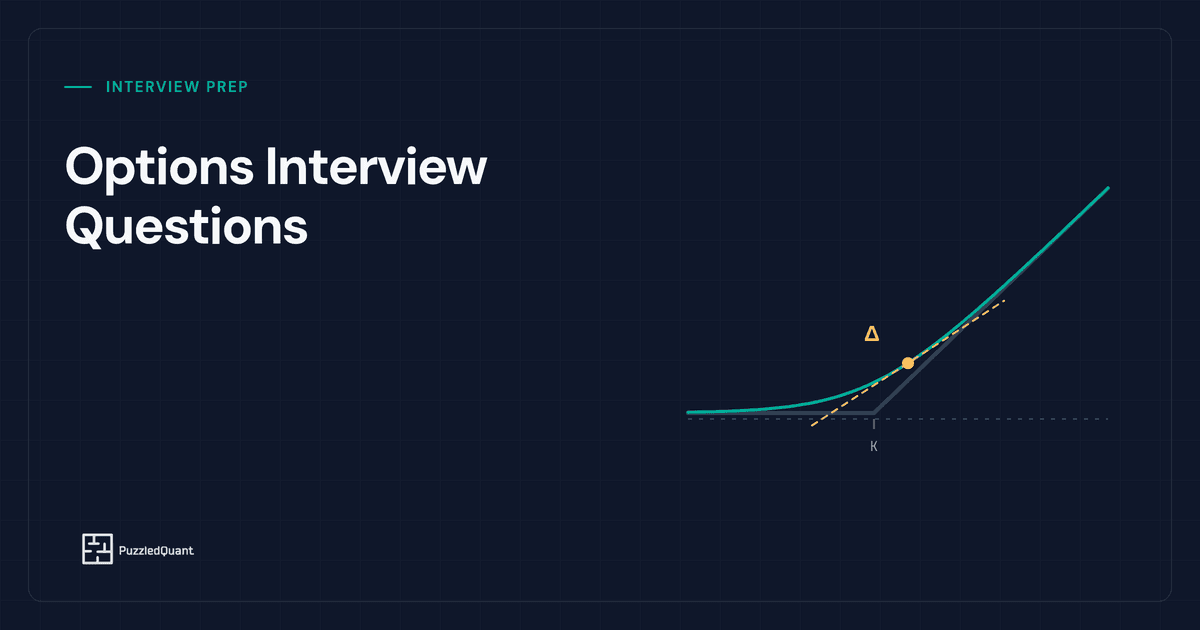
Options questions are the most reliably asked finance questions in quant trading interviews, and the most reliably over-prepared for in the wrong way. Candidates memorise the Black-Scholes formula and then cannot say what happens to a call's price when volatility doubles, or why a delta-hedged option makes money on a day the stock moves a lot.
Trading firms that make markets in options, including Optiver, Susquehanna (SIG), IMC, Akuna Capital, Citadel Securities and Jane Street, do not want derivations. They want intuition fast enough to trade on: turn a price into its sensitivities, and reason about how those sensitivities move when the market does.
This guide covers the five families of options questions that come up, with worked examples in the style these firms ask. Formulas appear only where you need them.
1. Put-call parity and arbitrage
The one identity you cannot fumble. For European options on a non-dividend-paying stock with the same strike and expiry :
The intuition is more useful than the formula. A long call plus a short put pays at expiry no matter what happens, which is exactly a forward contract. So the call minus the put must cost what a forward costs today, or there is free money.
Worked question. Stock at 100. The 100-strike call is 10 and the 100-strike put is 7, both expiring in a year. Rates are zero. Is there an arbitrage?
With zero rates, parity says call minus put should equal 100 − 100 = 0. Here it is 3, so the call is rich relative to the put. Sell the call, buy the put, and buy the stock. You collect 10, pay 7 and pay 100: a net outlay of 97. At expiry the position is worth exactly 100 whatever the stock does, because the short call and long put together deliver the stock at 100. You lock in 3.
Interviewers extend this in predictable directions: add interest rates, add a dividend (which lowers the forward, so lowers calls and raises puts), or ask you to find the arbitrage from three prices out of four.
The bounds that come with it. A call is never worth more than the stock, never worth less than its intrinsic value against the discounted strike, and an American call on a non-dividend-paying stock is never optimally exercised early, so it is worth the same as the European call. Be ready to argue each in one sentence.
2. One-step binomial pricing
The cleanest way to show you understand risk-neutral pricing, and a common whiteboard question.
Worked question. A stock is at 100 and will be either 120 or 80 in one year. Rates are zero. Price a 100-strike call.
The call pays 20 in the up state and 0 in the down state. Replicate it: hold shares and some cash . In the up state ; in the down state . Subtracting, , and . Today that portfolio costs 0.5 × 100 − 40 = 10, so the call is worth 10.
The equivalent risk-neutral view: find the probability that makes the stock a fair bet, , so , and the call is worth 0.5 × 20 = 10.
The trap follow-up. "Suppose the stock goes up with probability 90%. Does the call price change?" No. The price comes from replication, and the replicating portfolio does not care about real-world probabilities. Those are already reflected in today's stock price. Candidates who answer "yes, the call is worth more" fail this question more often than any other options question.
3. Black-Scholes in the limits
You will not be asked to derive Black-Scholes. You will be asked how it behaves.
- Volatility to zero. The stock grows at the risk-free rate with certainty, so a call is worth its intrinsic value against the forward, or zero.
- Volatility to infinity. A call's value tends to the stock price. The put tends to the discounted strike.
- Time to expiry to zero. Prices collapse to intrinsic value.
- Deep in the money. A call behaves like the stock minus the discounted strike, with delta near 1.
And one approximation every options trader carries around: for an at-the-money option with low rates,
The 0.4 is . Worked question: stock at 100, implied volatility 20%, one year, at the money. Rough call price? 0.4 × 0.2 × 100 × 1 = 8. The exact Black-Scholes value with zero rates is 7.97. Being able to produce that in five seconds, and to say it scales with the square root of time, is exactly the fluency being tested.
4. The Greeks as intuition
Know what each Greek means, its sign for a long call and a long put, and where it is largest.
- Delta: sensitivity to the stock price. About 0.5 for an at-the-money call, near 1 deep in the money, near 0 far out of the money. A put's delta is the call's delta minus 1, which follows straight from parity. Delta is often loosely called the probability of finishing in the money; it is close to that for short-dated options but not equal, and saying so is a point in your favour.
- Gamma: how fast delta changes. Highest at the money, and it grows as expiry approaches, because a short-dated at-the-money option flips from worthless to in the money on a small move.
- Theta: time decay. Long options lose value as time passes, all else equal. Gamma and theta come together: if you own gamma, you pay theta for it.
- Vega: sensitivity to implied volatility. Highest for at-the-money, longer-dated options.
Typical rapid-fire questions. What happens to the gamma of an at-the-money option as expiry approaches? It rises sharply. You are long a call and the stock rallies hard; is your delta higher or lower? Higher, because you are long gamma. Which has more vega, a one-month or a one-year at-the-money option? The one-year, roughly in proportion to the square root of time.
5. Delta hedging and where the money comes from
The question that separates candidates who have memorised the Greeks from those who understand them: you buy an option and delta-hedge it continuously. When do you make money?
Over a short interval, a delta-hedged long option has P&L of roughly
The gamma term is always positive: every move, in either direction, earns you something, because you rebalance by buying low and selling high. The theta term is the rent. Under Black-Scholes, theta is priced so that the two cancel exactly when the stock moves at the implied volatility. So the result is the core of options trading in one sentence: a delta-hedged long option makes money when realised volatility exceeds the implied volatility you paid, and loses when it falls short.
A related market-making question: make me a market on a one-day at-the-money straddle, stock at 100, annual volatility 16%. Use the rule of 16: there are about 256 trading days in a year and the square root of 256 is 16, so a 16% annual volatility is a 1% daily move. The expected absolute move of a normal variable is about 0.8 standard deviations, so the straddle is worth about 0.8 × 1% × 100 = 0.80. Quote around it, and be ready to widen if the interviewer tells you earnings are tomorrow.
How to prepare
- Do the classic questions by hand, then out loud. Parity arbitrage, one-step binomial pricing, the at-the-money approximation, the straddle. Speed matters: these are warm-ups in a trading interview, not the main event.
- Learn the Greeks as shapes. Sketch delta, gamma, theta and vega against the stock price for short-dated and long-dated options until you can draw them without thinking.
- Read one practitioner book. Sheldon Natenberg's Option Volatility and Pricing is the standard for trading interviews. John Hull's Options, Futures, and Other Derivatives covers the theory if you need it, and Euan Sinclair's Volatility Trading goes deeper on realised versus implied volatility.
- Practise pricing under uncertainty, not just pricing. Options market making is quoting a price on an uncertain payoff while traders who may know more than you pick off whichever side you got wrong. That skill is trained by making markets, not by reading.
Practise on PuzzledQuant
Risk-neutral pricing is expected value with the right probabilities, so the base skill is fast, reliable expectation. The Expected Value and Probability problems in our bank, graded the moment you submit and tagged by the firms that ask them, are where that speed comes from.
For the trading side, the Dice Market Maker has a Make mode where you publish your own bid and ask on hidden dice. Noise traders pay you the distance from fair value but walk away from a market that is too wide, and informed traders, who already know the outcome, only trade the side you priced wrong, with each round showing which of your fills were adverse. That is adverse selection, the central problem of options market making, in a game you can play in five minutes. Our guide to market making games in interviews covers how firms test the same skill, and 80 in 8 keeps the arithmetic behind quick pricing sharp.
Frequently asked questions
What options questions are asked in quant trading interviews?
Put-call parity and spotting arbitrage, pricing with a one-step binomial tree, how Black-Scholes prices behave as volatility or time change, the meaning and shape of the Greeks, delta hedging and the link between realised and implied volatility, and quick market-making questions such as pricing a straddle. Options market makers like Optiver, SIG, IMC and Akuna ask them most.
Do I need to know the Black-Scholes formula for a quant interview?
You should know its inputs and how the price behaves in the limits, and be able to use the at-the-money approximation of roughly 0.4 times volatility times stock price times the square root of time. Trading interviews rarely ask for a derivation. Researcher and desk-quant interviews at banks are more likely to.
What is put-call parity?
The relationship that a European call minus a European put with the same strike and expiry equals the stock price minus the present value of the strike. It holds because a long call plus a short put pays the same as a forward contract at expiry. If market prices break it, there is an arbitrage.
Why does a delta-hedged option make or lose money?
A delta-hedged long option earns from gamma, since rebalancing buys low and sells high on every move, and pays theta as time passes. The two balance when the stock moves at the implied volatility. If realised volatility is higher than the implied volatility you paid, you make money; if lower, you lose.
What books help with options interview questions?
Sheldon Natenberg's Option Volatility and Pricing is the standard for trading roles. John Hull's Options, Futures, and Other Derivatives covers the theory, and Euan Sinclair's Volatility Trading is useful on realised versus implied volatility. Heard on the Street and the red book include interview-style options questions.