Quant Internships for Summer 2028: The Timeline, the Online Assessments and a Six-Month Plan
When quant internship applications for summer 2028 open, what each firm's online assessment tests, which role to target, and a month-by-month plan to be ready before you apply.
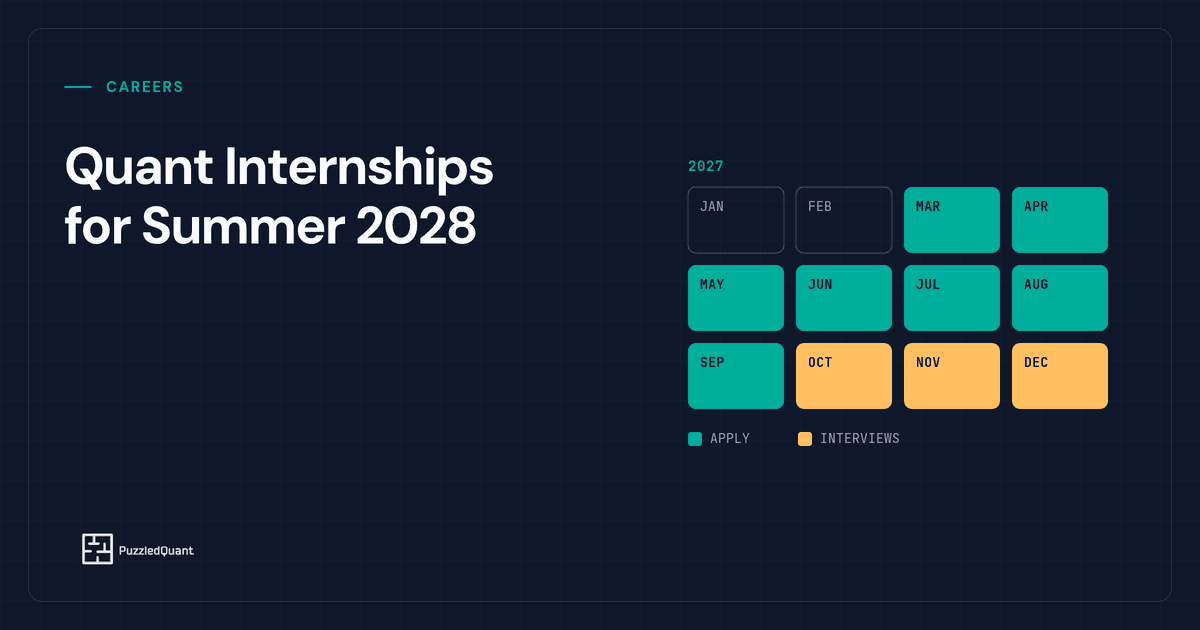
Quant internship recruiting runs on a calendar most students discover a year too late. The internships that start in summer 2028 will mostly be decided in the second half of 2027, and the earliest routes in, the insight weeks and discovery programmes that fast-track candidates, open in the first months of 2027. If you are a student aiming at a quant trading, research or developer internship for summer 2028, the preparation window is now, and it is shorter than it looks.
This guide covers the timeline, what the online assessments test, how to pick a role, and a month-by-month plan from December to the week applications open.
The timeline
Firms announce dates differently every year, so treat these windows as the pattern from recent cycles rather than a schedule. The shape has been stable for several years.
December 2026 to spring 2027: early programmes. Insight weeks, discovery days and diversity programmes aimed mainly at first- and second-year students, run by firms including Jane Street, Citadel and Citadel Securities, Optiver, SIG, Hudson River Trading and IMC. Several of them offer a fast track into the following summer's internship process. A growing share of eventual interns come through these routes, and their deadlines arrive months before the main postings.
Spring 2027: Europe's buy side opens. In recent cycles some London funds have opened their next-summer internships as early as March, well ahead of the US.
July to September 2027: the main US window. Most prop shops, HFT firms and large funds post their summer 2028 internships in this stretch. In the last cycle, Jane Street opened in mid-July and Citadel in early August, and most of the market followed within a few weeks.
Within days of applying: the online assessment. Almost every pipeline starts with a timed test, often sent within 48 to 72 hours of applying, sometimes before a human has read your resume.
October to December 2027: interviews and superdays. Phone screens, then final rounds. Most elite seats are filled by late autumn, even when application portals stay open into winter.
Early 2028: stragglers. Additional headcount and off-cycle roles, with far fewer seats.
Why applying early matters so much
Nearly every firm reviews on a rolling basis: seats are offered as strong applications arrive, and the portal looks the same whether thirty seats are left or three. A strong candidate who applies in October can face a much harder process than a slightly weaker one who applied in July, purely because of timing. The single highest-leverage decision in the whole cycle is to be ready to apply in the first week a posting goes up.
That means the preparation has to be done before the postings appear, because the online assessment follows within days.
What the online assessments test
What a quant interview actually tests
Assessments vary by firm and by track, but they fall into a few families.
- Mental arithmetic under time pressure. The best known is Optiver's 80 in 8: eighty arithmetic questions in eight minutes, no calculator. Flow Traders, IMC, Akuna and others run similar timed numeracy tests. They are pass-or-fail gates, and they are the most trainable part of the process.
- Probability and expected value. Short timed problems on dice, cards, coins and conditional probability, sometimes with betting decisions attached.
- Sequences and pattern recognition. Number series and logic puzzles, especially at trading firms.
- Game-based and cognitive assessments. Some firms use third-party platforms with games that measure risk-taking, attention and decision speed. You cannot cram these, but familiarity with the format reduces nerves.
- Coding. For developer and many research tracks: two or three algorithmic problems on a coding platform, typically on the harder side of standard interview problems.
Our guide to market making interview games covers the trading-specific formats in more depth.
Choose your track before July
Most firms let you apply to one track per season, and the preparation differs a lot between them. Decide early.
- Quant trader: mental math, probability, expected value, market making and betting games, quick decisions with incomplete information.
- Quant researcher: probability and statistics at greater depth, linear algebra, some machine learning, research-style problems, and coding in Python.
- Quant developer / software engineer: algorithms and data structures, C++ (or the firm's language), systems and low-latency design, and some probability.
If you are torn, our comparison of quant researcher, trader, developer and C++ engineer roles covers what each does day to day, how they interview and what they pay.
A six-month plan, December to June
The plan assumes you are a student targeting summer 2028, starting in December 2026, and aiming to apply the week postings open in July 2027. Adjust the intensity to your starting point, not the order.
December: foundations and early programmes. List the insight and discovery programmes you are eligible for and their deadlines, and apply to the ones that fit. Check your probability fundamentals: conditional probability, expectation, common distributions. If they are shaky, fix them now with a textbook before you touch interview books.
January and February: the core. Work through the canonical probability and brain teaser problems, the material covered by the classic books in our quant interview books review. Attempt before reading solutions. Start a daily ten-minute arithmetic habit now; speed builds slowly and compounds.
March: graded practice and the European window. Move from reading to solving unseen problems with your answers checked. If you are considering London buy-side roles, watch for postings now. Developer candidates should be doing algorithm practice several times a week.
April: track-specific depth. Traders: market making games, betting and sizing, estimation with confidence intervals. Researchers: statistics, linear algebra, a small research project you can talk about. Developers: C++ depth, data structures, systems basics.
May: resume and firm research. Write a one-page resume that leads with quantitative evidence: competition results, research, projects with numbers attached. Read real resumes from people who got the offers. Build your target firm list, split into reach, target and safer firms, and read each firm's careers pages.
June: assessment readiness. Take timed mock assessments under real conditions until your arithmetic scores are comfortably above the bar. Prepare your answers to "why trading" and "why this firm". Set up alerts so you know the day each posting goes live.
July onward: apply in the first week, then interview. Apply as postings open, expect assessments within days, and keep practising through the autumn interview season. Our superday guide covers the final round.
How PuzzledQuant fits the plan
Each stage of the plan maps to something on the platform.
- Foundations and the core (December to March). The problem bank has 1,160+ problems across probability, expected value, brain teasers, combinatorics, Markov chains and game theory, graded as soon as you submit and tagged by the firms known to ask them. Use Problem Sets to keep a running list of misses to revisit, and the Question of the Day to keep a daily habit.
- Assessment speed (all six months). 80 in 8 and Arithmatic Mania drill the timed arithmetic tests, and Find the Next in Sequence covers sequence tests.
- Trader depth (April). The Dice Market Maker, Card Counting and Fermi Estimation games train market making and calibrated estimation.
- Developer depth (April). Twenty C++ exercises built around low-latency interviews, and OCaml exercises for Jane Street.
- Resumes (May). Real resumes from people who landed quant offers, by role.
- Applications (July). The jobs board lists quant trader, researcher and developer openings, with filters for role, location and company that you can save. If you use Claude or ChatGPT, connect PuzzledQuant over MCP and ask it to search for internships at your target firms.
Frequently asked questions
When do quant internship applications open for summer 2028?
Most US trading firms and funds are expected to post summer 2028 internships between July and September 2027, following the pattern of recent cycles. Some European buy-side firms open as early as spring 2027, and insight and discovery programmes that can fast-track candidates run from late 2026 through spring 2027.
When should I start preparing for quant internship interviews?
Six months before applications open is a good target, so around December 2026 or January 2027 for summer 2028. Online assessments often arrive within days of applying, and most firms review applications on a rolling basis, so you need to be ready before the postings go up, not after.
What is on a quant internship online assessment?
Usually some combination of timed mental arithmetic (such as Optiver's 80 in 8), short probability and expected value problems, number sequences and logic puzzles, game-based cognitive tests, and for developer and research tracks, algorithmic coding problems.
Can first- and second-year students get quant internships?
Yes, mostly through early programmes such as insight weeks and discovery days, which several firms aim specifically at first- and second-year students and which can lead to fast-track interviews. Some firms also accept sophomores for their main summer internships. Check each programme's graduation-year requirements.
Should I apply to quant trader, researcher or developer internships?
Choose based on what you enjoy and what you are strongest at, and decide before applications open, since most firms limit you to one track per season. Traders need fast arithmetic and decision making, researchers need deeper statistics and coding, and developers need strong algorithms, C++ and systems knowledge.