Optiver Interview Questions: The Process, the Games and How to Prepare
How Optiver's trading interview works, what its own FAQs say about mental math and the online assessment, a worked market making example, and a prep plan.
Optiver is a market maker, and its interview process is built to find people who will make good prices quickly. That shows up everywhere: a timed arithmetic test at the start, probability and expected value questions asked at speed, and trading games where you have to quote, trade and adjust while someone watches. None of it requires a finance background. A lot of it requires composure.
Optiver publishes more about its process than most firms. It has campus FAQs for the US, Sydney and Europe, plus interview tips for software engineers. Everything below either comes from those pages (as of October 2026) or is labeled as what candidates commonly report. Where the two disagree, believe Optiver. Its own FAQ says the best way to check a rumor about the process is to ask your recruiter.
What Optiver says it looks for
Optiver is direct about the mental math question. In its US and Sydney FAQs, the answer to "how correlated is being good at mental math and being good at trading?" is that mental math is "necessary but insufficient". Beyond quantitative skill, a trader has to "be a quick decision-maker and stay cool under pressure", and the firm says it assesses these "throughout the interview process."
So the headline skill is not arithmetic. It is making a reasonable decision quickly, with numbers involved, while things are moving. Arithmetic matters because slow arithmetic eats the time you need to decide.
Optiver also states that no financial experience is needed. Its US FAQ says many new hires knew nothing about the trading industry before joining, and its training program teaches the rest. For the online assessment, it suggests practicing "activities that involve quick problem-solving skills, such as mental math and strategy games."
On character, the firm describes its people as "team players who are constantly looking to improve, curious to understand other perspectives and actively contributing to discussions." The Sydney FAQ describes options market makers as people who are "comfortable making decisions under uncertainty" and have "a flair for numbers". That reads as a fair description of what the interview is trying to detect.
The interview process
Optiver's pages describe the shape. The details vary by office, role and year.
For quantitative trading roles, the Sydney FAQ gives the sequence as: application, online assessment, behavioural interview, final interview day. The US FAQ says the process "starts with an online assessment followed by behavioral and technical interviews," with a final virtual interview with the hiring team. As of its September 2025 update, the US FAQ also says all final rounds would be virtual and that "final interviews do not require technical preparation." That surprises people who expect the last round to be the hardest technical one. Ask your recruiter what your final day will involve.
For quantitative research roles, the Sydney sequence adds a step: application, online assessment, behavioural interview, technical assignment, final interview.
For software and FPGA roles, the process includes technical interviews, and Optiver says you can code in whichever language you are most comfortable with. Its software engineering tips say the interviews avoid "standard Leetcode puzzles or brainteasers" in favour of technical discussions about data structures, complexity and design choices.
A few published rules are worth knowing before you apply:
- No calculators in the assessments (Sydney FAQ).
- One attempt per eight months. The European FAQ says assessments can only be taken once every eight months, there are no retakes once you start, and the same eight-month waiting period applies after an unsuccessful application for a similar role.
- One campus role at a time in the US, so apply to your first preference.
- Responses are fast. Optiver says it aims to reply to applications within about a week, and to candidates within about a week after an interview.
The test candidates talk about most is the arithmetic screen. It is commonly reported as 80 questions in 8 minutes, with wrong answers penalized. Optiver does not publish the format on the pages above, and the assessment platform has changed over the years, so treat that as candidate-reported. Our 80 in 8 game copies the 80-questions-in-8-minutes shape, though not the penalty: it only moves on when you answer correctly.
The kinds of questions
Mental arithmetic under time pressure. Multiplication, division, decimals and fractions, quickly and without a calculator. It shows up as its own test, and again inside every other question: a market making round with slow arithmetic is a market making round you lose.
Probability and expected value. Dice, cards and coins, asked conversationally. The probability is usually not deep. What makes these questions hard is speed and the expectation that you will turn the number into a decision.
Market making and trading games. The format most associated with Optiver. You quote a bid and an ask on an uncertain quantity, an interviewer or a simulation trades against you, and new information arrives as you go. Candidates describe individual games and, in some years, group simulations. Our guide to market making interview games covers the common formats in detail.
Sequences and pattern questions. Candidates frequently report number sequence questions in Optiver's assessments. They reward a fast, systematic search for structure: differences, ratios, alternating patterns, squares and primes.
Behavioural questions. Optiver has a dedicated behavioural interview early in the process, rather than a few questions tacked on at the end. Its software engineering tips recommend reflecting on past experiences, using the STAR structure and practising out loud.
Options, for some roles. Optiver is an options market maker, and for experienced or options-focused candidates basic options intuition can come up. Campus candidates are not expected to know it already. Our options interview questions post is a gentle start if you want the vocabulary.
A worked example
This one is written in the style candidates describe from Optiver's trading rounds. It is our own example, not a reported question.
I roll two fair dice and you get the higher of the two numbers, in dollars. Make me a market on this game.
The fair value is the expected maximum. The maximum equals when both dice are at most but not both at most , so
The weights are 1, 3, 5, 7, 9 and 11 over 36. Multiply each by its face and add: , so the expected maximum is .
You do not have to finish that before you speak, and in a game you would not. A reasonable first answer is "the max is skewed high, a single die is worth 3.5, so somewhere around 4.5. I'll make it 4.2 at 4.8 while I tighten it." Then compute, and narrow to something like 4.4 at 4.55.
Most of the interview happens in the follow-ups:
- The interviewer buys at your ask. Should you move your prices? If you think they are trading at random, no. If they might know something, a little. Saying which, and why, is the point.
- One die is revealed as a 2. Now the max is the other die, unless it shows 1, in which case it is 2. The value is . Re-quote around it straight away.
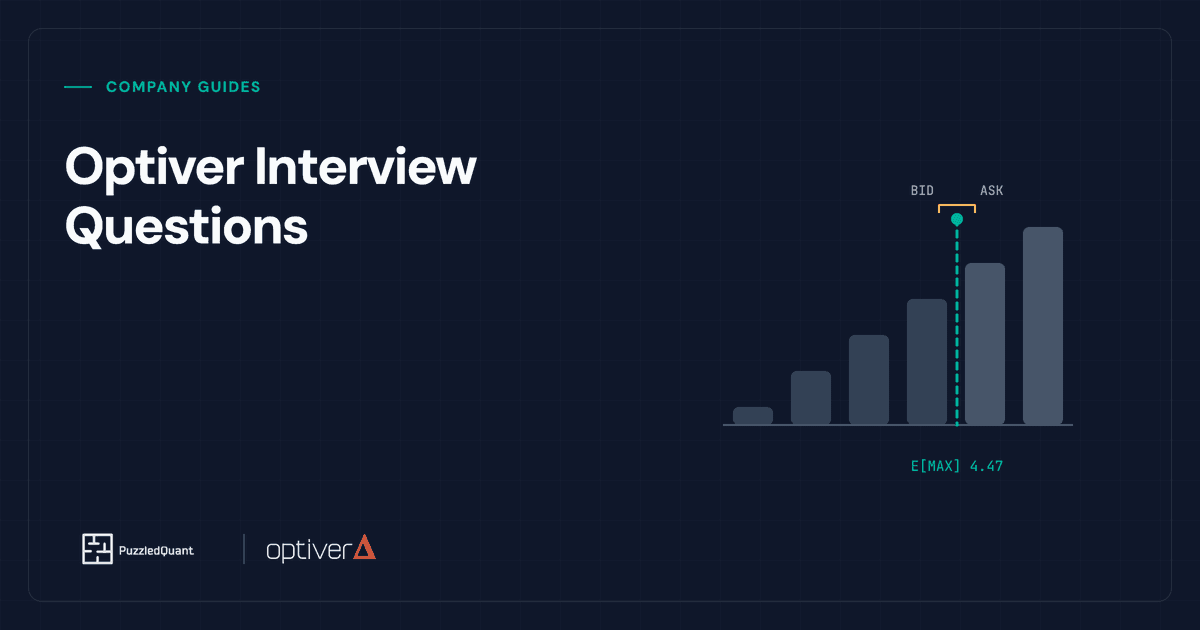
- You get the max of three dice instead. The same method works: . Candidates who memorized "4.47" are stuck. Candidates who understood the trick finish in a minute.
Under the arithmetic, this tests whether you quote something sensible before you have the exact answer, then update cleanly as information arrives. That is very close to the "quick decision-maker" Optiver describes.
How to prepare
Read Optiver's own FAQ for your office. The US, Sydney and Europe pages answer different questions, and between them they settle most of the rumors you will see online. Read the one for the office you are applying to, and ask your recruiter about anything they leave out.
Make mental math automatic. Since mental math is "necessary but insufficient", it has to be good enough that it stops costing you attention. Ten minutes a day on 80 in 8, which copies the reported 80-questions-in-8-minutes format, or on Arithmatic Mania. Optiver's Sydney FAQ says calculators are not allowed in its assessments, so practise without one. Our game has no skip button and no penalty, so practise the skip decision separately: after a timed set, count the wrong answers you should have left blank. Our guide to mental math for quant interviews covers the shortcuts worth learning.
Drill sequences. Do a few minutes of Find Next in Sequence after your arithmetic set. The point is to build a checklist you run without thinking: first differences, second differences, ratios, interleaved sequences.
Practise market making against something that trades back. This is hard to rehearse alone, and it is where candidates underprepare. The Dice Market Maker has you publish a bid and an ask against both noise traders and informed flow, with a position limit and a breakdown of which fills hurt you. Card Counting trains expected value as cards leave the deck. Both are part of the game library.
Do Optiver-tagged problems. Our problem bank tags problems with the firms known to ask them. Work through the Optiver problems, then widen to probability and expected value for volume. Our expected value interview questions post walks through the techniques that come up most.
Prepare the behavioural interview properly. It is a real stage, and it comes early. Have true stories ready about a hard problem, a mistake you fixed, a disagreement and why trading. Optiver's own advice is to practise them out loud and "be authentic".
Use the eight-month rule to your advantage. You only get one attempt at the assessments in that window, so do not take them cold to "see what they are like". Prepare first, then start.
For the full picture across every round and role, our complete guide to preparing for quant interviews lays out 4, 8 and 12-week plans.
What to do the week before
Keep the daily arithmetic going; speed fades faster than people expect. Do two or three market making games a day, and say your quotes out loud as if someone were trading with you. Re-read your behavioural stories, look up what Optiver trades from your target office, and get a list of real questions for your interviewers. Then sleep. A game that rewards quick, calm decisions is the worst place to show up tired.
If your final round is virtual, test your setup the day before: camera, microphone, a quiet room and scratch paper within reach.
Frequently asked questions
What is the Optiver online assessment?
It varies by office and year. Optiver's FAQs confirm an online assessment comes first for trading roles, and its Sydney FAQ says calculators are not allowed. Candidates most often describe a timed mental arithmetic test, reported as 80 questions in 8 minutes with a penalty for wrong answers, alongside other numerical and reasoning tests. Assessments can only be taken once every eight months.
Do I need finance knowledge for an Optiver interview?
No. Optiver states that no financial experience is necessary and that many new hires knew nothing about trading before joining. Its training program teaches the trading. The interview tests mental math, probability, quick decision-making and how you behave under pressure.
How important is mental math at Optiver?
Important but not sufficient. In Optiver's own words, mental math is "necessary but insufficient" for trading; you also need to make quick decisions and stay calm under pressure, and the firm assesses both throughout the process. Practise until arithmetic is automatic, then spend most of your time on market making and decision questions.
What is the Optiver final round like?
It depends on office and year. Optiver's Sydney FAQ calls it a "final interview day" for trading roles. Its US FAQ (September 2025) says final rounds were virtual and "do not require technical preparation". Candidates commonly describe trading games, probability questions and conversations with senior traders. Ask your recruiter what your own final day will include.
Can I reapply to Optiver if I am rejected?
Yes, after a waiting period. Optiver Europe applies an eight-month waiting period after an unsuccessful application for a similar role, and assessments cannot be retaken within eight months. Optiver's US FAQ says candidates rejected during a recruiting season can reapply for the same role when the next season opens.