Expected Value Questions in Quant Interviews: 12 Classics, Solved
Twelve expected value problems that keep appearing in quant interviews, each solved with the technique it teaches, plus the variant an interviewer uses to check you did not memorize it.
If quant interviews have a native language, it is expected value. Probability questions, betting games, market-making rounds and most brain teasers come down to the same move: write down what something is worth on average, and do it faster and more reliably than the person across the table.
The good news is that the space of expected value questions is smaller than it looks. A handful of techniques solves almost all of them. The twelve problems below are classics that keep appearing at Jane Street, SIG, Optiver, Citadel and the rest, chosen so that together they cover every technique you need. Each comes with its answer, the technique it teaches, and the variant an interviewer uses to check you did not just memorise it.
Try each one before reading the solution. The answers are only useful after an attempt.
The five techniques
- Linearity of expectation. The expectation of a sum is the sum of the expectations, whether or not the pieces are independent. Combined with indicator variables, this solves a startling number of counting questions in one line.
- First-step analysis. Condition on what happens first, write an equation for the expectation in terms of itself, and solve. This is how you handle waiting times and Markov chains.
- Symmetry. When several quantities must be equal by symmetry, you often get the answer without computing anything.
- Geometric waiting times. If each trial succeeds with probability , the expected number of trials to the first success is .
- Backward induction. In games with stopping decisions, solve from the last decision backwards: the value of continuing is the threshold for stopping.
The twelve classics
1. Waiting for a six
How many rolls of a fair die, on average, until you roll a six?
Answer: 6. Each roll succeeds with probability 1/6, so the waiting time is geometric with mean 1/(1/6).
Technique: geometric waiting times. The variant: how many rolls until you have seen a six and a five? Not 12. Wait for whichever comes first (probability 2/6 a roll, so 3 rolls), then for the other one (6 more): 9.
2. One optional reroll
Roll a die and be paid its value, with the option to reroll once and take the second roll. What is the game worth?
Worked example: one optional reroll
Answer: 4.25. A reroll is worth 3.5, so keep 4, 5 or 6 and reroll otherwise: ½ × 5 + ½ × 3.5.
Technique: backward induction. The variant: two rerolls? With one reroll left the game is worth 4.25, so on the first roll keep only 5 or 6: (5 + 6)/6 + (4/6) × 4.25 = 14/3 ≈ 4.67.
3. Two heads in a row
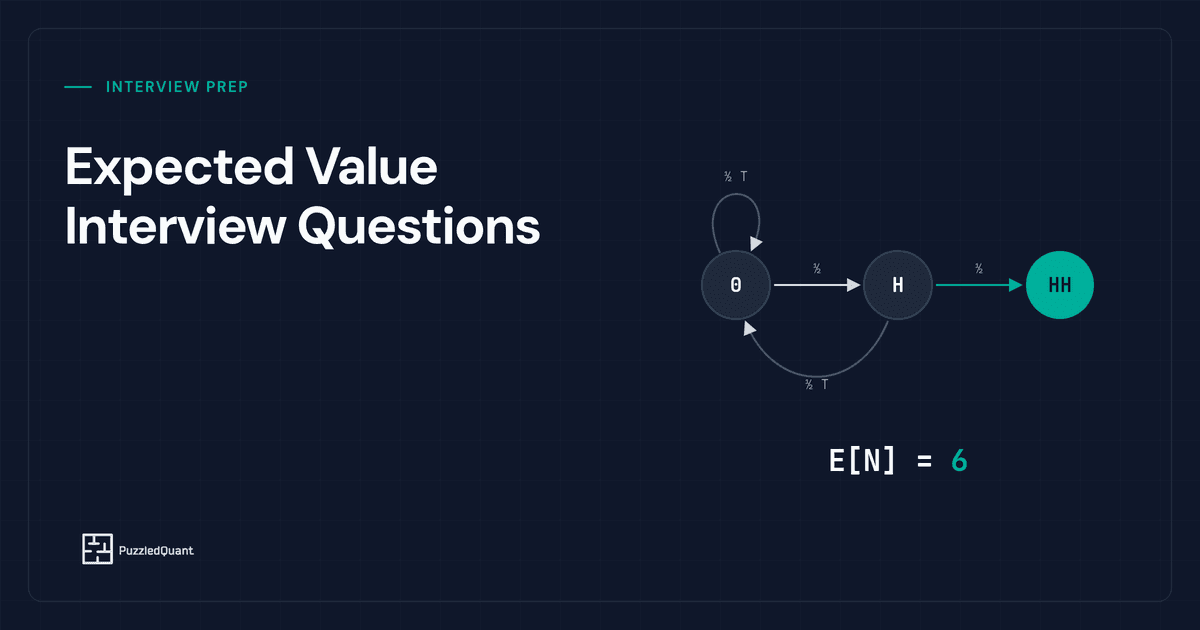
How many flips of a fair coin, on average, until two heads in a row?
Answer: 6. Let be the expected flips from scratch and after one head. Then and . Solving gives .
Technique: first-step analysis on a Markov chain. The variant: heads then tails? 4: wait for a head (2 flips), then for a tail (2 more). The answers differ because after a failed attempt at HH you are back at the start, while after a head on the way to HT, a further head keeps you where you are. Interviewers love this pair because it breaks intuition.
4. Collecting all six faces
How many rolls, on average, until every face of a die has appeared?
Answer: 14.7. Once you have seen faces, a new one appears with probability , so that stage takes rolls on average. Summing: 6(1 + 1/2 + 1/3 + 1/4 + 1/5 + 1/6) = 6 × 49/20 = 14.7.
Technique: split into geometric stages and use linearity. The variant: how many rolls to see all faces of a 20-sided die? 20 × the 20th harmonic number, about 72. In general .
5. The hat-check problem
A hundred people throw their hats in a pile and each takes one at random. How many people get their own hat back, on average?
Answer: 1. Let indicate that person gets their own hat. Each has probability 1/100, and there are 100 of them, so the expected total is 1. The indicators are not independent, and it does not matter.
Technique: linearity with indicators. The variant: a thousand people? Still 1, which is exactly why the question is asked.
6. Shared birthdays
In a room of 30 people, how many pairs share a birthday, on average?
Answer: about 1.19. There are pairs, each matching with probability 1/365, so 435/365.
Technique: linearity over pairs. The variant: how many people do you need for the expected number of shared pairs to reach 1? Solve : about 28. Compare with the more famous 23 for a better-than-even chance of at least one match; the two questions are different, and saying why is a good answer.
7. Runs in coin flips
Flip a fair coin 10 times. How many runs (maximal blocks of identical outcomes) do you expect?
Answer: 5.5. The first flip starts a run, and each of the other nine starts a new one with probability ½ (whenever it differs from the flip before). So 1 + 9/2.
Technique: indicators on "something starts here". The variant: a biased coin with heads probability ? Each later flip differs from the previous with probability , giving 1 + 9 × 2p(1−p).
8. Cards until the first ace
Deal cards from a shuffled deck. How many cards, on average, up to and including the first ace?
Answer: 10.6. The four aces split the 48 other cards into five gaps, and by symmetry each gap holds 48/5 = 9.6 cards on average. Add one for the ace itself: 10.6. In general, for special cards among .
Technique: symmetry. The variant: cards up to and including the first heart? 53/14, about 3.79.
9. The maximum of uniforms
Draw two independent uniform numbers between 0 and 1. What is the expected value of the larger?
Answer: 2/3. The maximum satisfies , so its density is and its mean is . Symmetry gives the same answer faster: two points cut the interval into three pieces with equal expected length.
Technique: symmetry, or the CDF of a maximum. The variant: the maximum of uniforms? . This is the basis of many auction and bidding questions.
10. Breaking a stick
Break a stick of length 1 at two uniformly random points. What is the expected length of the shortest piece?
Answer: 1/9. For the three pieces, the expected shortest is 1/9 and the expected longest is 11/18. The clean derivation uses the fact that the spacings of uniform points behave symmetrically; the formula for the shortest of pieces is .
Technique: symmetry of spacings. The variant: what is the probability the three pieces form a triangle? 1/4: they do unless some piece is longer than 1/2.
11. A fair gambler's ruin
You start with 5 and bet 1 on fair coin flips until you reach 10 or go broke. How many flips does it take, on average?
Answer: 25. Starting from with absorbing barriers at 0 and , the expected duration of a fair walk is , here 5 × 5.
Technique: first-step analysis gives a recurrence whose solution is quadratic. The variant: what is the probability you reach 10? 1/2, and in general , because a fair game's expected wealth stays constant. That second argument, a martingale in all but name, is what a strong candidate offers unprompted.
12. Summing uniforms past 1
Keep drawing uniform numbers between 0 and 1 until their sum exceeds 1. How many draws do you need, on average?
Answer: . The probability that the first draws sum to less than 1 is (the volume of a simplex). The expected count is the sum of the probabilities that you have not finished yet, .
Technique: the tail-sum formula, . The variant: what is the expected sum when you stop? , by Wald's identity.
How interviewers actually use these
Nobody will ask you problem 3 word for word. They will ask it with three heads, or a biased coin, or "first to get HH beats first to get HT, who is favoured?" The classics are vocabulary. Being fluent means seeing which technique a new question needs within the first thirty seconds. The same holds for the rest of the toolkit: our probability interview questions cover conditioning, symmetry and counting, and quant brainteasers cover the puzzles with no expectation in sight.
Three habits make that happen:
- Name the technique before you calculate. Out loud: "this is a waiting time, I'll condition on the first flip." It helps you, and interviewers grade the narration.
- Check with a small case. Before trusting a general formula, test it on or , where you can count directly.
- Always do the variant. After every problem you solve, change one thing and solve it again. That is the difference between knowing an answer and owning a method.
Practise on PuzzledQuant
The problem bank is built for exactly this. Filter to Expected Value, Probability or Markov Chains and work through problems you have not seen, with your answer graded as soon as you submit. The answer box accepts expressions, including square roots and factorials such as 5!, so you can enter an answer in its natural form instead of working out the decimal.
A few features matter for this kind of drilling:
- Next follows your filter. Open a problem from a filtered list and Next problem steps through that same list, so an hour on expected value stays on expected value.
- Re-drill what you missed. Mark a solved problem as not solved and try it again cold a few days later.
- Problem Sets. Keep a set of the variants that tripped you up, and clear it before your interviews.
- Video walkthroughs. A growing number of problems have a solution video, available on premium, that walks through the technique step by step.
- Ask your AI for a variant. Connect Claude or ChatGPT over MCP, and after you solve a problem ask it to find similar ones in the bank.
If you are still deciding how expected value fits around the other rounds, start with our complete guide to preparing for quant interviews.
And the Question of the Day puts one new problem in front of you every day, which is the easiest way to keep the habit going.
Frequently asked questions
What are expected value questions in quant interviews?
Questions that ask what a random quantity is worth on average: the number of rolls until a six, the value of a dice game with a reroll option, the number of people who get their own hat back. They test whether you can model a situation and compute an expectation quickly, and they underpin betting games and market-making rounds.
What is the best way to solve expected value problems quickly?
Recognise the technique first. Most problems use linearity of expectation with indicator variables, first-step analysis (conditioning on the first event), symmetry, geometric waiting times, or backward induction for stopping decisions. Naming the technique within the first thirty seconds is what makes you fast.
Why is the expected number of flips until HH different from HT?
Because of what happens after a partial match. Going for HH, a tail after the first head sends you back to the start, so the expected wait is 6. Going for HT, a head after the first head leaves you exactly where you were, still needing one tail, so the expected wait is only 4.
What is linearity of expectation?
The rule that the expected value of a sum equals the sum of the expected values, even when the parts are dependent. It lets you count expected matches, fixed points, runs or pairs by adding the probabilities of simple indicator events, which is often a one-line solution.
How many expected value problems should I practise before a quant interview?
Enough to see every common technique several times and to solve unfamiliar variants without help, which for most candidates means a few dozen problems done properly rather than hundreds skimmed. Track the ones you miss and redo them a few days later.