PuzzlesAlgorithms

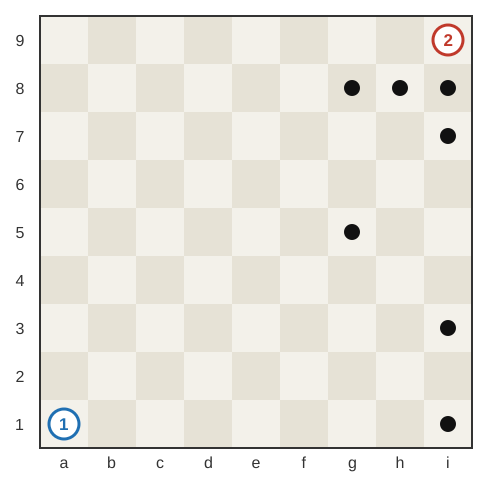
A particle sits at the centre of square a1 (marked 1) on a 9 x 9 board. It wants to reach the centre of the
corner square i9 (marked 2). Columns are a to i (left to right) and rows are 1 to 9 (bottom to top). The black
dots (o below) are posts.
 9  .  .  .  .  .  .  .  .  2
 8  .  .  .  .  .  .  o  o  o
 7  .  .  .  .  .  .  .  .  o
 6  .  .  .  .  .  .  .  .  .
 5  .  .  .  .  .  .  o  .  .
 4  .  .  .  .  .  .  .  .  .
 3  .  .  .  .  .  .  .  .  o
 2  .  .  .  .  .  .  .  .  .
 1  1  .  .  .  .  .  .  .  o
    a  b  c  d  e  f  g  h  i
Posts: g5, g8, h8, i1, i3, i7, i8 (seven posts).
How the particle moves
The particle moves by a sequence of swings. Each swing goes like this.
- Throw. The particle throws its rope to any post it can see. It can see a post when no other post lies
exactly on the straight segment between the particle and that post. - Swing. The particle then swings in a circle around that post. It turns clockwise or anticlockwise, whichever it
likes, and keeps turning the same way for the whole swing. It must stay inside the outer edge of the board. It may
stop only at the centre of a square with no post on it. It may pass over squares without stopping. - Other posts. Posts have zero width. The particle may not pass through a post, so a post lying exactly on its
circular path blocks it. If the sweeping rope meets another post, the rope catches on that post and bends there.
The particle then keeps turning the same way around the new post, on the shorter piece of rope that is left. This
can happen several times in one swing. (If several posts on one straight line meet the rope at the same moment, the
rope bends at the one farthest from the current pivot.) The particle may stop at the exact moment the rope touches
a post. - Removal. When the swing is over, the post the rope was thrown to is removed from the board. Posts the rope
merely caught on stay where they are. - Cost. A swing costs 1/D², where D is the length of the rope when it is thrown. That is the straight-line
distance from the particle to the post. The side of a square has length 1.
The particle may visit the same square more than once.
Question. What is the smallest possible total cost of getting from a1 to i9? Give the answer as an exact fraction.
Discussion (0)