
You have identical regular pentagonal tiles with side length 1. Each tile is laid flat on a table, and two tiles are attached when they share a full side.
For integers k ≥ 0 and j ≥ 0, the hairpin H(k, j) is built as follows. Directions such as "top" and "upper-left" refer to the page.
- Base B. One tile with a vertex pointing straight down, so its top side is horizontal. Going clockwise from the top, its sides are: top, upper-right, lower-right, lower-left, upper-left. (A tile with a vertex pointing straight up has, clockwise from the top vertex: upper-right, lower-right, bottom, lower-left and upper-left sides.)
- Right arm R1, R2, …, R(2k+1).
- R1 is attached to B's top side, so R1 has a vertex pointing straight up.
- When Ri has a vertex pointing up (i odd), R(i+1) is attached to Ri's upper-right side.
- When Ri has a vertex pointing down (i even), R(i+1) is attached to Ri's upper-left side.
- Left arm L1, L2, …, L(2j+1).
- L1 is attached to B's upper-left side, so L1 has a vertex pointing up.
- When Li has a vertex pointing up (i odd), L(i+1) is attached to Li's upper-left side.
- When Li has a vertex pointing down (i even), L(i+1) is attached to Li's top side.
H(k, j) has 2k + 2j + 3 tiles in total. You may take it as given that no two tiles of a hairpin overlap, apart from sharing boundary points. The last tiles of the two arms, R(2k+1) and L(2j+1), are called the top tiles.
Here is H(1, 2), with its base in yellow and its two top tiles (R3 and L5) in grey:
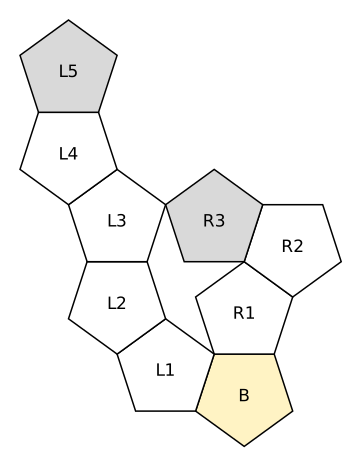
The distance between two tiles is the smallest distance between a point of one and a point of the other, so tiles that touch, even at a single point, are at distance 0. For example, in H(1, 1) the two top tiles touch, and in H(0, 1) they are exactly 1 apart.
Question. Consider every hairpin with at most 15 tiles. What is the smallest positive distance between the two top tiles of such a hairpin?
Answer format: the exact value, or a decimal rounded to seven decimal places.