


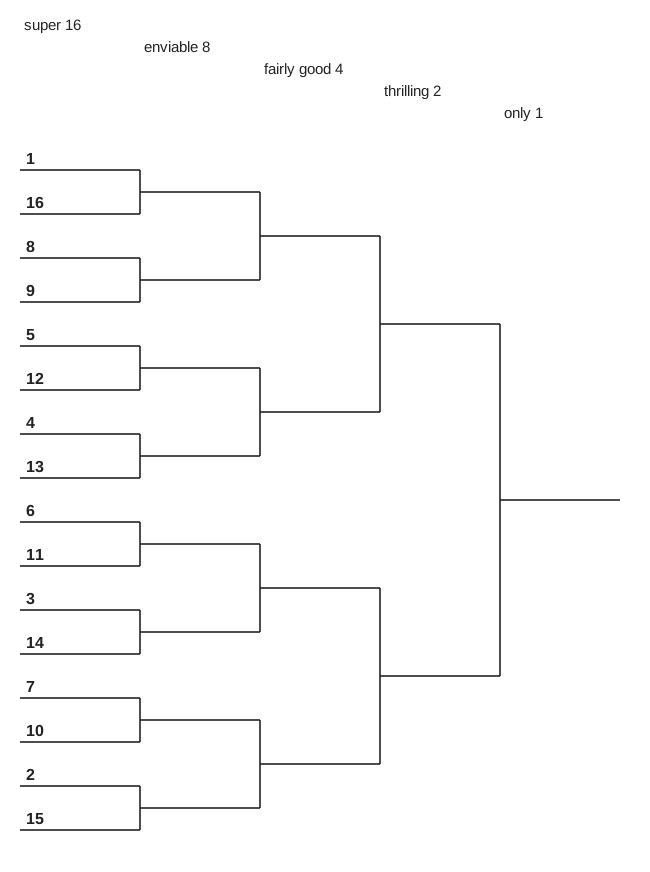
There’s a certain insanity in the air this time of the year that gets us thinking about tournament brackets. Consider a tournament with 16 competitors, seeded 1-16, and arranged in the single-elimination bracket pictured above (identical to a “region” of the NCAA Division 1 basketball tournament). Assume that when the X-seed plays the Y-seed, the X-seed has a Y/(X+Y) probability of winning. E.g. in the first round, the 5-seed has a 12/17 chance of beating the 12-seed. This same rule applies to every game in every round, and the outcomes of different games are independent.
Suppose the 2-seed has the chance to secretly swap two teams’ placements in the bracket before the tournament begins. So, for example, say they choose to swap the 8- and 16-seeds. Then the 8-seed would play their first game against the 1-seed and have a 1/9 chance of advancing to the next round, and the 16-seed would play their first game against the 9-seed and have a 9/25 chance of advancing.
The 2-seed may swap any two teams in the bracket (the 2-seed itself may be one of the two), and the swap changes only bracket positions, not the teams’ seeds, so win probabilities still follow the Y/(X+Y) rule based on seeds.
Which two seeds should the 2-seed swap to maximize its own probability of winning the tournament, and by how much does that swap increase this probability?
Answer format: three comma-separated numbers: the smaller of the two swapped seeds, the larger of the two swapped seeds, and the absolute increase in the 2-seed's probability of winning the tournament (new probability minus the original, unswapped probability), expressed in percentage points to 7 significant figures.